
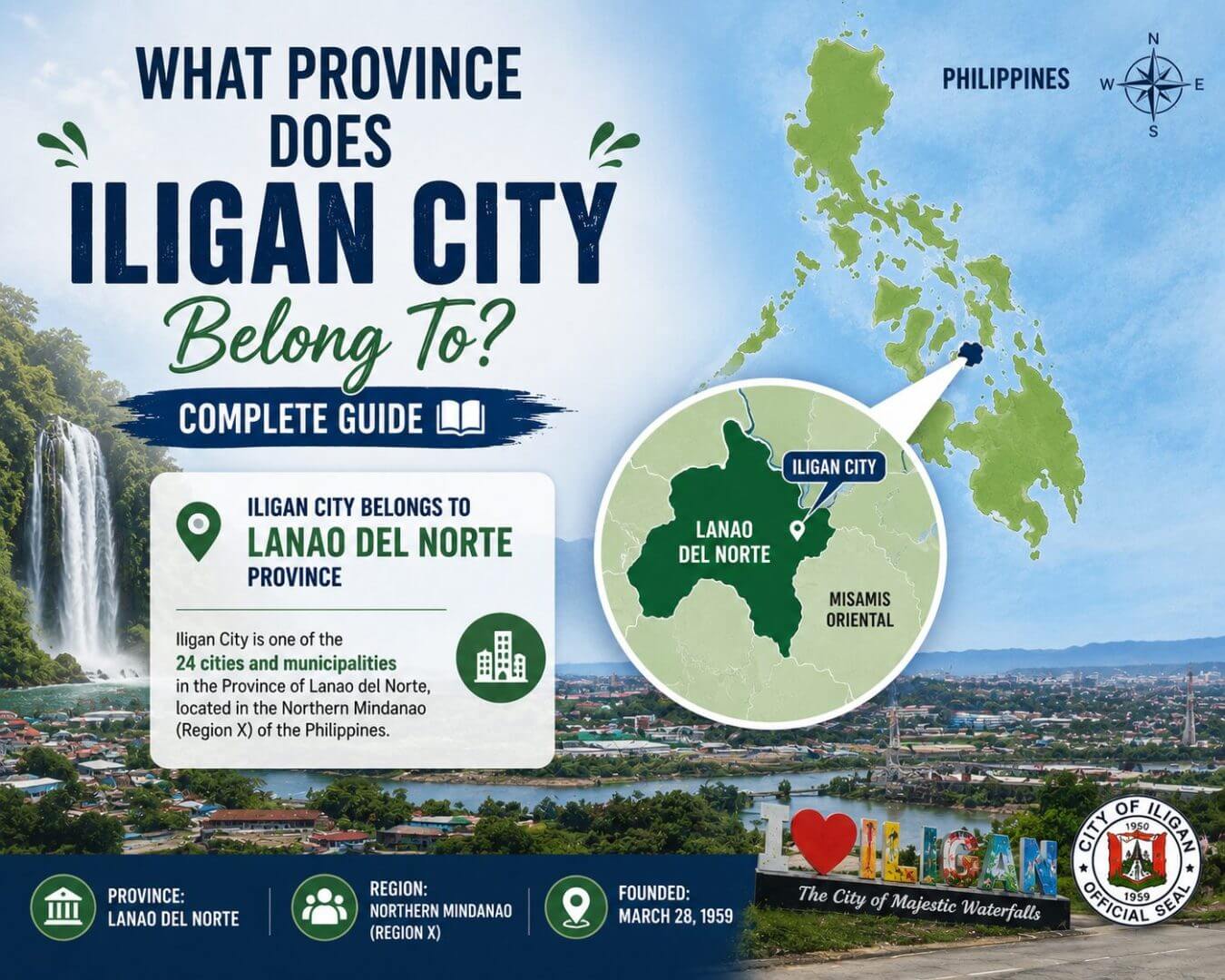
The straightforward answer generates confusion: Iligan City doesn’t belong to any province. Yet it has historical and geographic ties to Lanao del Norte. The reality is more nuanced and reflects a unique Philippine administrative classification that most people don’t understand.
Iligan City is a Highly Urbanized City (HUC), a status that grants it independence from provincial governance while maintaining geographic and cultural connections to its surrounding region. This distinction fundamentally shapes how the city operates, how residents vote, and how it relates to neighboring provinces—yet most sources gloss over the explanation or leave it ambiguous.
This guide resolves that confusion while explaining the historical evolution that created this status, the BARMM question that complicated it further, and the practical implications that matter to residents and businesses.
Understanding Iligan City’s Provincial Status
Iligan City is located geographically within the boundaries of what was once Lanao del Norte province, yet it operates as a completely independent local government unit (LGU) with no provincial oversight. This independence is the defining characteristic of its Highly Urbanized City status.
To understand what this means, you must first understand the hierarchy of Philippine municipalities. The country classifies cities into three categories:
Component Cities remain subordinate to provincial governments. They send representatives to the provincial board, and the provincial governor retains authority over certain functions. A component city is essentially a large municipality with city powers but provincial superiors.
Independent Component Cities function autonomously—no provincial government supervises them—yet remain part of provinces for some purposes (regional representation, resource allocation). They represent a middle ground: independent operations but not administratively separate.
Highly Urbanized Cities operate with complete independence and report directly to the national government. No province exercises any authority. The mayor answers to the national executive branch. The city council operates without provincial oversight. Revenue collection, budgeting, and administrative decisions are entirely the city’s domain.
Iligan is the third type: fully independent. It funds itself through its own revenue generation (industrial taxes, business licenses, services, utilities). It doesn’t receive provincial subsidy; it doesn’t report to a provincial government; it has no provincial superior.
This explains the apparent paradox: Iligan is geographically surrounded by Lanao del Norte municipalities, yet technically doesn’t “belong” to the province. It’s a political entity separate from the province despite physical proximity.
The Historical Connection Between Iligan City and Lanao del Norte
Understanding current status requires historical context. Iligan wasn’t always independent.
1950s transition: Iligan was originally part of Lanao del Norte province when the province was established. The city’s growing population and economic importance prompted its conversion to component city status in 1950. This gave Iligan limited autonomy while still reporting to the provincial governor.
1983 elevation: The turning point came in 1983 when Iligan was reclassified as a highly urbanized city—a promotion reflecting its population growth (then approximately 150,000), industrial development, and economic capacity to sustain itself independently. This elevation fundamentally altered its relationship with Lanao del Norte from subordinate to peer.
The 1983 reclassification wasn’t arbitrary. The Philippines uses specific criteria to determine HUC status: population (typically 250,000+ in Metro Manila regions, 100,000+ elsewhere), annual income (₱50 million or higher), and economic independence demonstrated through industrial/commercial activity. Iligan met all three criteria through waterfall-powered hydroelectricity and manufacturing.
Present relationship: Although administratively independent since 1983, Iligan and Lanao del Norte maintain cultural and geographic ties. Both are part of Northern Mindanao (Region X). Both are predominantly Cebuano-speaking in Christian areas and Maranao-speaking in Muslim areas. Both identify as Mindanaoan. But administratively, they’re completely separate entities.
This historical trajectory matters because it explains why sources sometimes list Iligan “as part of” Lanao del Norte—older references reflect the pre-1983 reality. Current information should distinguish historical from present status.
What Makes a Highly Urbanized City Different
The HUC classification represents a unique Philippine governance structure that most countries don’t have. Understanding what makes it different requires comparing it to other city classifications.
Provincial jurisdiction: Component cities and independent component cities remain within provincial jurisdiction for certain purposes—they follow provincial regulations, send representatives to provincial boards, and operate under provincial oversight in some domains. Highly urbanized cities have zero provincial jurisdiction. A provincial governor has no authority over Iligan. The provincial legislature cannot pass ordinances binding Iligan residents.
Congressional representation: All cities send representatives to the national Congress. But component cities’ representatives are part of provincial delegations; their voting power is diluted by other provincial representatives. Highly urbanized cities send their own congressional representative directly, separate from provincial delegations. Iligan City’s congressman represents only Iligan, giving the city independent voice at the national level.
Budget and revenue allocation: Component cities receive budget support from provinces. The provincial government controls certain funds and allocates them to component cities. Highly urbanized cities don’t rely on provincial subsidy. Iligan generates its own revenue through business taxes, industrial licensing, utilities, and services. The city keeps its tax revenue and allocates it independently through its city council and budget office.
Electoral independence: All registered voters in Iligan vote for Iligan’s mayor, city council, and city-level officials. But component city voters also participate in provincial elections (voting for provincial governor, provincial board). Iligan residents do not vote in Lanao del Norte elections. They don’t vote for the Lanao del Norte governor, provincial board, or provincial measures. Iligan elections and Lanao del Norte elections are completely separate.
Administrative autonomy: This is perhaps the most consequential difference. Iligan can create its own ordinances without provincial approval. It can enter contracts independently. It can purchase land, hire employees, and make policy decisions without provincial interference. Component cities have limited autonomy; HUCs have absolute autonomy in all local matters.
In practice, HUC status means Iligan functions essentially as a city-state within the Philippine system—completely self-governing in local matters, reporting only to the national government.
Iligan City’s Geographical Location and Boundaries
Geographic precision clarifies administrative confusion. Iligan occupies coordinates 8.7163° N, 124.2340° E and spans approximately 80 square kilometers.
Boundaries and bordering municipalities:
- North: Macajalar Bay (coastal boundary; no bordering municipality)
- South and Southeast: Lanuza and Ubay municipalities of Lanao del Norte
- West: Linamon municipality of Lanao del Norte
- East: Pantao Laya and other municipalities of Lanao del Sur
The city’s boundaries were formally demarcated during the 1983 HUC reclassification. These boundaries represent the urban and developed areas that justified HUC status at that time. Surrounding municipalities remain rural or semi-urban.
The coastal position is strategically significant. Iligan’s deep-water port (Port of Iligan) provides direct maritime access, eliminating dependence on neighboring Cagayan de Oro’s port. This independence was foundational to the case for HUC status—cities needed demonstrated capacity to function without provincial resources, and Iligan’s port and hydroelectric facilities provided proof.
Administrative Region and Governance Structure
Despite independence from Lanao del Norte province, Iligan remains part of the larger Northern Mindanao region (Region X) for administrative planning and resource allocation purposes. This region includes five provinces and six highly urbanized cities. Regional designation affects which development programs apply, how infrastructure funding flows, and regional coordination.
Iligan’s governance structure:
The Mayor serves as chief executive, elected for three-year terms by registered voters citywide. The mayor controls city departments, oversees budget execution, and represents the city at provincial and national forums. The current system allows mayors to run for a maximum of three consecutive terms, after which they must sit out one election.
City Council functions as the legislative body, comprising the vice mayor plus city council members elected by district or at-large (the Philippines uses a mixed system). The council passes ordinances, approves the city budget, and provides legislative oversight.
City administrative offices report to the mayor rather than provincial authorities. The City Assessor (property taxes), City Treasurer (finances), City Health Office, and City Schools Division operate under the mayor’s jurisdiction. This is the key distinction: all city functions are city-controlled.
Iligan maintains no offices in the Lanao del Norte provincial capitol. The city government building (City Hall) is the seat of all local authority. Provincial offices in Iligan (if any exist) are peripheral—serving provincial residents who live in Iligan temporarily or handling provincial business unrelated to city governance.
Iligan City and the Bangsamoro Question
Iligan’s independence took on new meaning with the 2019 Bangsamoro plebiscite. The Bangsamoro Autonomous Region in Muslim Mindanao (BARMM) was created as an autonomous region specifically encompassing areas with historically Muslim populations. The region was designed to replace the Autonomous Region of Muslim Mindanao (ARMM).
The critical question: Would Iligan City be included in BARMM?
Geographically, Iligan sits between Lanao del Norte and Lanao del Sur—both have significant Muslim populations. Historically, the area has Maranao heritage. Yet Iligan itself is approximately 80% Christian, 15% Muslim.
The 2019 plebiscite result: Iligan voted decisively against inclusion in BARMM. The city rejected becoming part of the autonomous region. The referendum was held January 21, 2019, and Iligan’s voters chose to remain outside BARMM—independent and part of the mainstream national system rather than autonomous under BARMM.
This vote clarified Iligan’s identity. Despite Muslim heritage in surrounding areas, Iligan identified as a multi-religious, secular city preferring national government rather than autonomous regional status. The city’s economic integration with the national system, industrial orientation, and Christian majority population created a preference for remaining administratively linked to Manila rather than Cotabato (BARMM headquarters).
Current status: Iligan City is definitively outside BARMM. It remains part of Region X (Northern Mindanao) under the national government. BARMM encompasses Lanao del Sur, Maguindanao, Sulu, Tawi-Tawi, and Basilan—but not Iligan.
This distinction matters practically. Iligan residents pay national taxes, follow national laws, and participate in national elections. They don’t navigate autonomous region governance structures. Business operations follow national Philippine law, not BARMM’s separate legal framework.
Practical Implications of Iligan City’s Status
Understanding Iligan’s provincial status isn’t academic—it has real implications for residents and businesses.
Taxation: Iligan collects its own business taxes and property taxes. Residents and business owners pay city, not provincial, assessments. The city keeps these revenues and allocates them to city priorities. This is why Iligan can fund services independently—it controls its revenue stream.
Services and utilities: The city operates its own water and power utilities, manages its own solid waste system, and funds its own health services. Residents interact with city agencies directly, not provincial agencies. This autonomy often enables faster service delivery and response to local needs.
Business licensing: Entrepreneurs establish businesses under city jurisdiction. Business permits, liquor licenses, and trade registrations are handled by city offices. This creates a consistent regulatory environment without overlapping provincial and city authorities.
Electoral participation: Iligan voters participate in national and city elections—voting for president, senators, congressional representative, mayor, and city council. They do not participate in Lanao del Norte elections. Residents from other municipalities living temporarily in Iligan may vote in provincial elections at their home municipality addresses, but they cannot vote in Iligan provincial elections (since Iligan has none).
Legal disputes: Cases involving city ordinances or city administrative matters are handled through city courts and city legal mechanisms. Lanao del Norte courts have no jurisdiction. This separation prevents jurisdictional confusion and ensures local consistency.
Development planning: City zoning, urban planning, and infrastructure development are city decisions. The Iligan City Development Plan is created and executed by city government. Provincial development plans don’t apply to Iligan territory.
Frequently Asked Questions
Q: Is Iligan City still part of Lanao del Norte? No. Iligan hasn’t been part of Lanao del Norte province since 1983 when it was reclassified as a highly urbanized city. It’s an independent local government unit reporting to the national government, not to any province.
Q: Is Iligan City part of BARMM? No. Iligan voted against BARMM inclusion in the 2019 plebiscite and remains outside the Bangsamoro Autonomous Region. It’s part of Northern Mindanao (Region X) under national government.
Q: What provinces border Iligan City? Iligan borders Lanao del Norte municipalities (Lanuza, Ubay, Linamon) and Lanao del Sur municipalities. The city itself is not part of either province.
Q: What language do they speak in Iligan City? Cebuano is the primary language in Christian areas; Maranao is spoken in Muslim-majority districts. Filipino (Tagalog) is used in formal contexts; English is widely understood in commercial and tourism sectors.
Q: When did Iligan City become highly urbanized? Iligan was reclassified from component city to highly urbanized city in 1983, based on population (150,000+), economic capacity, and ability to generate independent revenue.
Q: Does Iligan City have its own congressman? Yes. Iligan City sends its own representative to the national Congress, separate from Lanao del Norte’s congressional delegation. The congressman represents only Iligan City.
Iligan City’s provincial status—technically independent, historically connected—reflects the Philippines’ complex administrative evolution. The distinction between “not part of Lanao del Norte” and “no provincial jurisdiction” matters for governance, taxation, representation, and daily life. Understanding this unique classification resolves confusion that otherwise persists across countless sources.

Recent Hot Topics
Photography and Creativity Take Center Stage at Digital Creatives Hub Iligan
Stunning Moments Captured: Winners of the 3rd Wahig Festival Photography Contest Announced
Camiguin’s Sunken Cemetery Tells a Story of Resilience and Heritage