
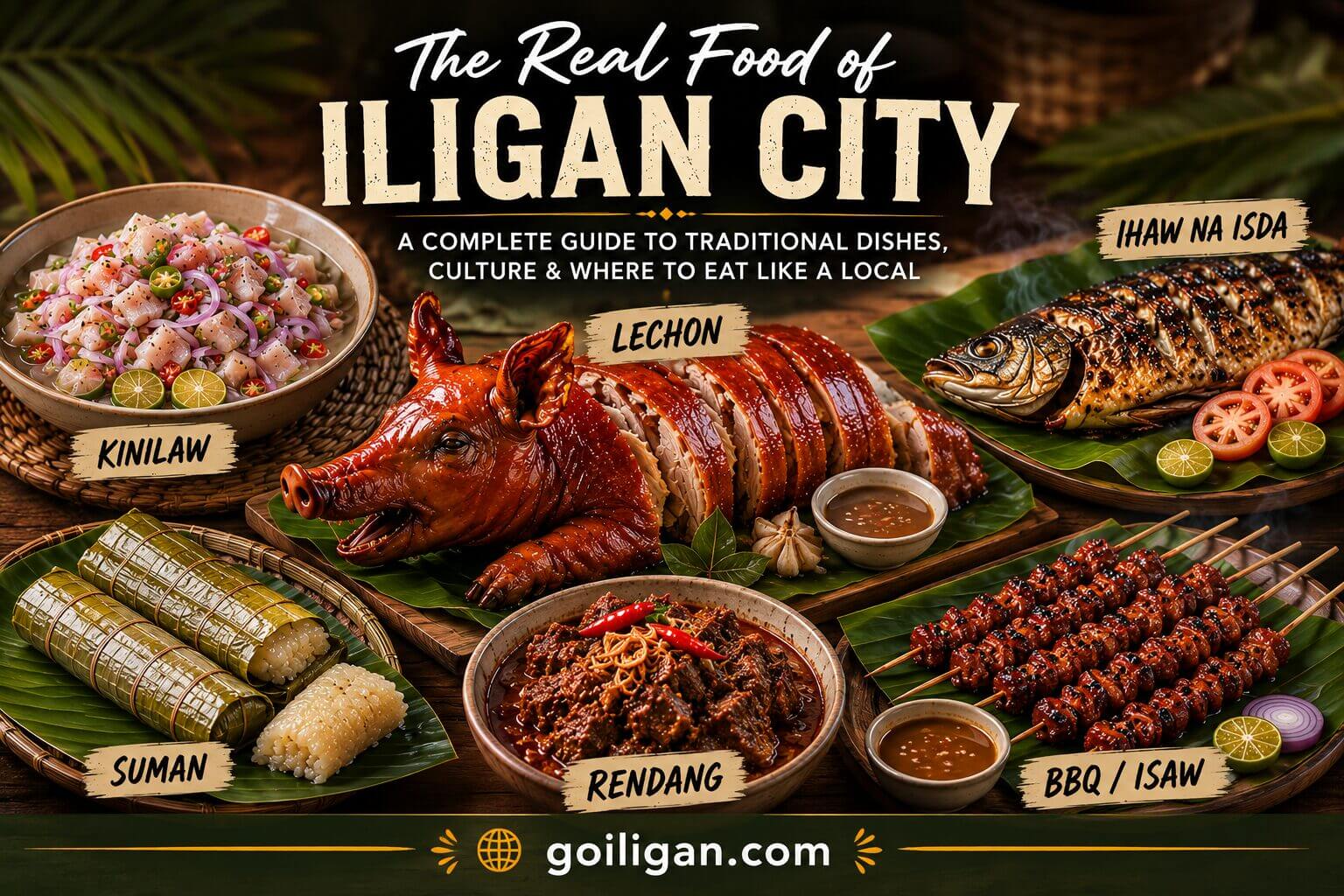
There’s a reason food lovers who visit Iligan City come back with full stomachs and wider horizons. This isn’t the Philippines you’ve seen on every travel list. There’s no single headline dish, no viral reel that captures it fully. What Iligan has is something richer — a culinary identity built across centuries, shaped by Maranao Muslim traders, Visayan settlers, Spanish colonial history, and a coastline that delivers fresh seafood daily to anyone willing to look for it.
Iligan is officially classified as a highly urbanized city in Lanao del Norte, Mindanao. It sits along Iligan Bay on the Mindanao Sea, and its geography — water on one side, mountains and waterfalls on the other — has always shaped what people here eat. The city is known nationally as the “City of Majestic Waterfalls,” but among those who know it well, it’s just as much a food city, with a dining culture that has quietly been building its own identity for generations.
This guide covers the real food of Iligan: the dishes with cultural roots, the street food worth hunting down, the Maranao flavors you won’t find in Manila, the practical budget breakdowns, and the specific neighborhoods and markets where authentic eating actually happens.
Iligan’s Culinary Identity: Where Three Food Cultures Meet
Understanding Iligan’s food starts with understanding who built this city.
The indigenous Maranao people of the Lanao region have inhabited the lake areas and surrounding territories for centuries. Their cuisine — built around spices like turmeric, lemongrass, and ginger, with heavy use of coconut milk and freshwater fish — forms the deepest root of what makes Iligan’s food distinct from the rest of Mindanao.
Layered on top of that is the Visayan influence. As Cebuano-speaking migrants from the Visayas settled into Iligan throughout the 20th century, they brought their own techniques: vinegar-cured seafood, charcoal grilling, and a preference for clean, acidic flavors. This is where Iligan’s kinilaw tradition gets its particular edge.
Then there’s Spanish colonial influence, present across the Philippines but absorbed differently in Iligan. The city’s Catholic heritage runs deep, and with it came fiesta culture — the tradition of cooking lechon and large communal dishes during town celebrations, religious feasts, and family gatherings centered around the city’s patron saint, St. Michael the Archangel.
None of these influences displaced each other. They coexist in Iligan’s kitchens, markets, and carinderias, producing a food scene that is genuinely layered without being confused about what it is.
Worth Knowing: Iligan’s food culture remains largely under-documented compared to cities like Davao, Cagayan de Oro, or Zamboanga. That’s changing — but it means what you’ll find here hasn’t been tourist-packaged yet. That’s an advantage for the curious eater.
Iligan’s Lechon: The City’s Festive Centerpiece
If you ask any Iliganon what food defines a major celebration in the city, the answer is almost always lechon. Whole-roasted pig has been the centerpiece of Philippine fiestas for generations, and Iligan’s version carries its own character.
What makes it different from Cebu lechon?
Cebu lechon is internationally recognized, and rightly so — it’s seasoned heavily with lemongrass, scallions, and other aromatics stuffed inside the cavity before roasting. The result is a deeply herbed, intensely flavored meat with crackling skin that needs no sauce.
Iligan’s lechon tradition is less about a single standardized recipe and more about how it’s cooked and served within the community context. Local lechon roasters in Iligan typically season the pig with a blend of local aromatics, and the roasting is done on open bamboo spits over slow-burning coals. The emphasis here is on the skin — it must be thin, uniformly golden, and genuinely crisp, what locals call bagaybay skin when done right.
Lechon in Iligan is almost never eaten without sarsa — a liver-based sauce thickened with bread or crackers, seasoned with vinegar, sugar, and spices. Some families use a lighter vinegar dip instead. Both work.
Where to find it: Lechon orders in Iligan are typically made through local lechon roasters operating out of residential-commercial areas in barangays like Tubod, Pala-o, and Hinaplanon. Many operate on a pre-order basis, especially for whole pigs. During the Iligan City Fiesta — celebrated every September 29 in honor of St. Michael the Archangel, the city’s patron saint — lechon demand spikes significantly. If you’re visiting around this period, expect lechon to be on nearly every table in the city.
Local Tip: For smaller groups, ask about lechon belly orders. Several local roasters offer lechon de leche (suckling pig) or belly portions as alternatives to full pigs. Prices vary based on market rates for live pigs, so always verify current pricing directly with roasters before ordering.
Fresh Seafood Specialties: Kinilaw and Grilled Fish
Iligan sits directly on Iligan Bay, part of the broader Mindanao Sea. This coastal access has always defined what locals eat — particularly in the city’s fish markets and along the coast in barangays like Tambacan and Suarez.
Kinilaw: The Visayan Ceviche
Kinilaw (also spelled kilawin in some regions) is raw or near-raw seafood cured in vinegar or citrus juice, typically with ginger, onion, chili, and sometimes coconut milk. It’s one of the oldest food preparations in Philippine coastal culture, predating Spanish colonization.
In Iligan, kinilaw is made using whatever’s fresh that morning. Common fish used include:
- Tanigue (Spanish mackerel) — the most prized kinilaw fish for its firm, clean flesh
- Pagi (stingray) — used by some local cooks for its unique texture
- Matambaka (bigeye scad) — commonly available and affordable
- Pusit (squid) — occasionally used in kinilaw or grilled whole
The Iligan version tends to lean toward a vinegar-forward cure, reflecting the Visayan influence. Some cooks finish with a small amount of coconut milk to soften the acidity — this is more common in preparations influenced by Maranao cooking traditions.
Grilled Fish at the Market
The freshest grilled fish experience in Iligan happens at Iligan City Public Market, located in the city center near the Quezon Avenue area. Come early morning — by 6 to 8 AM, the fish section is at its most active. Vendors sell whole fish that can be grilled on-site at adjoining ihaw-ihaw stalls, typically seasoned simply with salt and wrapped in banana leaf for steam-grilling, or cooked directly on coals.
Budget guidance: A full grilled fish meal (fish, rice, and a side of ensalada or soup) at market-side eateries typically runs between ₱80 and ₱180 depending on the fish variety and size. Prices shift with supply and season.
Best Time to Visit: Early morning market visits (before 9 AM) give you access to the freshest catch and the widest selection of fish varieties before daily stock depletes.
Maranao-Influenced Dishes: The Flavors Iligan Shares with the Lake
The Maranao people — one of the major Muslim ethnolinguistic groups in the Philippines — are indigenous to the Lanao del Sur region, with Marawi City as their cultural center. Iligan, positioned at the edge of this cultural sphere and serving as a commercial hub for people traveling between the coast and the lake region, has always had a significant Maranao presence.
This shows up directly in the food.
Rendang-Style Beef and Chicken
Rendang is one of the most recognized dishes of the Malay world — a slow-cooked dry curry made with coconut milk and a paste of lemongrass, galangal, turmeric, ginger, and chili. In Mindanao, particularly among Maranao cooks, a local version of rendang has been prepared for generations, though it is distinct from the Indonesian original in its spice ratios and finishing technique.
In Iligan, you’ll find rendang-style dishes at Muslim-owned eateries and halal food stalls, particularly in areas with higher Maranao population density. The local version is often less dry than its Indonesian counterpart, carrying more residual sauce. It’s eaten with steamed rice and frequently appears alongside other dishes rather than as a standalone centerpiece.
Palapa: The Maranao Condiment
If there is one culinary contribution from Maranao culture that deserves far more national attention, it is palapa. This is a toasted condiment made from sakurab (young scallion bulbs), turmeric, ginger, chili, and toasted coconut. The ingredients are pounded and cooked down into a dense, intensely savory-spicy paste that functions as a condiment, a flavor base for meats, or a side eaten directly with rice.
Palapa is not widely available outside Mindanao. In Iligan, it can be found at markets that serve the Muslim community, in halal food stalls, or purchased as a pasalubong from vendors in areas frequented by Maranao traders. It keeps well and is excellent with grilled fish, fried rice, or as a seasoning for plain boiled chicken.
Pyaganag and Tiyula Itum
Tiyula itum is a traditional Maranao and Tausug beef or chicken soup that gets its distinctive dark color from charred coconut — toasted until black, then ground and added to the broth along with ginger and other aromatics. The result is a soup with deep, smoky complexity and a broth unlike anything in mainstream Philippine cuisine.
Pyaganag is another Maranao preparation — a dish of fish or meat cooked in a heavily spiced coconut milk base using turmeric as the primary color agent, producing a vivid yellow dish with significant heat. It appears at celebrations and in traditional Maranao households.
These dishes require specific knowledge and ingredients to prepare properly. In Iligan, the best access point is through halal eateries near the public market or vendors catering to the Maranao community.
Cultural Note: When eating at Muslim-owned eateries or accepting food from Maranao hosts, alcohol is not present or appropriate. Use your right hand or utensils when eating. Accepting offered food is a gesture of respect in Maranao hospitality culture.
Street Food, Kakanin, and Pasalubong: What to Eat and Bring Home
Iligan’s street food scene is concentrated along a few key areas: the stretch around the public market, the night market near Quezon Avenue, and the food parks and clusters that emerge in the evening along major barangay roads.
Street Food Worth Knowing
- Isaw and barbecue stalls — chicken intestines, pork skewers, and ears grilled on charcoal, typically served with a spicier vinegar-chili dip than what you’ll find farther north
- Balut — fertilized duck egg, sold by roving vendors particularly in the evening, at approximately ₱15–₱25 per piece
- Fish balls and squid balls — fried on flat iron pans, served with sweet, spicy, or sweet-spicy sauce; a staple outside schools and near the market
- Kikiam — ground meat and vegetable roll wrapped in bean curd skin, fried and served with fish ball sauce
- Sinugba na baboy — grilled pork belly sold by weight at market-adjacent ihaw-ihaw stalls
Kakanin: Traditional Rice-Based Sweets
Kakanin are traditional Filipino rice-based sweets that appear across the country in regional variations. In Iligan:
- Puto — steamed rice cakes, often eaten with dinuguan or with butter and cheese
- Bibingka — rice cake cooked in banana leaf, best during the Christmas season
- Kutsinta — brown rice jelly cakes with a chewy, gummy texture, topped with grated coconut
- Suman — sticky rice cooked in coconut milk and wrapped in banana or palm leaves
Suman in Iligan: More Variety Than You Expect
Suman deserves its own section. It is one of the most culturally significant kakanin in the Philippines, and in Iligan and the broader Lanao del Norte region, multiple distinct versions exist. Here’s what you’re likely to encounter:
Suman sa Lihiya The most common type across the Philippines, including Iligan. Glutinous rice is soaked in lye water (lihiya), which gives the finished suman an alkaline flavor, a slightly chewy, almost elastic texture, and a yellowish tint. Wrapped in banana leaves and boiled until set. Eaten plain, with sugar, or with fresh grated coconut. The lye water treatment also acts as a natural preservative.
Suman sa Gata Made without lye water — glutinous rice is cooked directly in coconut milk (gata) with salt, and sometimes sugar. The result is richer and creamier than suman sa lihiya, with a more prominent coconut flavor and a softer, more pillowy texture. Wrapped in banana leaves and steamed or boiled. This version is particularly popular during fiestas and family gatherings.
Suman Malagkit A simpler preparation using glutinous rice (malagkit) cooked in coconut milk and sugar until thick, then wrapped and steamed until firm. Slightly sweet on its own, it’s commonly eaten with ripe mango when in season — a combination that is one of the better things you can eat in the Philippines at any price point.
Suman sa Ibos (Buri Palm Leaf Suman) Wrapped in buri palm leaves (from the buri palm, Corypha utan) rather than banana leaves, giving this version a distinctive shape — long, cylindrical, and tightly wound. The palm leaf imparts a subtle vegetal aroma to the rice during cooking. This style is more labor-intensive to prepare and is considered a traditional specialty. Finding it requires visiting the right market vendors — not every stall carries it.
Suman Pandan Glutinous rice infused with pandan (screwpine) extract before wrapping and steaming. The pandan gives the suman a natural green tint and a fragrant, slightly sweet herbal aroma that makes it immediately recognizable. One of the most aromatic kakanin variants and a crowd favorite with children and first-time visitors.
Suman Ube (Purple Yam Suman) A more festive variant incorporating ube (purple yam) extract or mashed ube into the glutinous rice mixture before steaming. The result is visually striking — a deep purple interior — with a mild ube sweetness layered over the coconut base. More commonly found during celebrations, fiestas, and Christmas season.
Suman Kamoteng Kahoy (Cassava Suman) Made from grated cassava rather than glutinous rice, this is technically a different base ingredient but falls under the same kakanin family and is sold alongside rice-based suman by the same vendors. Grated cassava is mixed with coconut milk, sugar, and sometimes grated coconut, then wrapped in banana leaves and steamed. The texture is denser and slightly grainy compared to rice suman, with a mild, starchy sweetness.
Local Tip: Suman vendors at Iligan City Public Market often sell multiple varieties from the same stall. Buying a mixed selection — two or three of each type — is the best way to taste the range without committing to a large quantity of any single variety. Most suman are priced at ₱5–₱20 per piece depending on size and type.
Best Time for Suman: While suman is available year-round in Iligan markets, the widest variety and highest quality appear during September around the City Fiesta and during the Christmas season (December). Vendors ramp up production for these periods, and specialty types like suman sa ibos and suman ube are more reliably found.
Pasalubong: What to Bring Home from Iligan
- Palapa — jarred or vacuum-packed Maranao spice condiment; the most distinctive food souvenir unique to this region
- Dried fish (daing/tuyo) — the public market carries a wide selection of dried and smoked fish varieties
- Suman assortment — wrapped suman travels well for short distances; pick a mixed selection from market vendors
- Native tablea (cacao tablets) — for thick, unsweetened hot chocolate; available from specialty and organic product vendors
- Local kakanin assortment — puto, kutsinta, and other rice cakes if consumed the same day
Where to Eat in Iligan: From Carinderias to Food Parks
Iligan’s restaurant landscape combines longstanding family establishments, carinderias, halal food stalls, and a growing number of food parks and casual dining spots.
Turo-Turo and Carinderias
The most authentic and most affordable eating in Iligan happens at turo-turo-style carinderias clustered around the public market, near Iligan City Hall along Sabayle Street, and in barangay commercial areas throughout the city. Point at pre-cooked dishes behind a glass counter and pay per dish, with rice typically included. Expect to eat a complete meal for ₱60–₱120.
Common dishes at Iligan carinderias: beef nilaga, pork adobo, ginataang gulay, pinangat na isda, mongo (mung bean stew), and various fried fish preparations.
Halal Dining Options
Iligan has a significant Muslim population and a number of established halal eateries, particularly in areas near the public market and in neighborhoods with higher Maranao community concentration. These establishments serve beef-based dishes, Maranao-influenced preparations, and halal-certified versions of standard Filipino dishes. Look for halal signage or establishments clearly operating within Muslim-community commercial areas.
Food Parks and Evening Dining
Iligan’s food park culture has grown in recent years, with several open-air food parks operating in the evenings offering grilled food, rice meals, and beverages in a casual, social setting. Popular with younger residents and families.
Budget Framework
| Dining Type | Typical Meal Cost Per Person |
|---|---|
| Turo-turo / Carinderia | ₱60–₱120 |
| Market-side eateries (grilled fish) | ₱80–₱180 |
| Casual restaurants | ₱150–₱350 |
| Food park dinner with drinks | ₱150–₱300 |
| Halal food stalls | ₱70–₱150 |
Prices are approximate and subject to change. Always verify current pricing directly.
Cooking Iligan Flavors at Home
Essential Ingredients
- Turmeric (luyang dilaw) — base of most Maranao-influenced dishes; use fresh rather than dried
- Galangal (langkawas) — related to ginger but with a sharper, citrusy, pine-like quality
- Lemongrass (tanglad) — used in Maranao spice pastes and mainstream Filipino cooking
- Coconut milk (gata) — fresh is significantly better than canned for coconut-forward dishes
- Sakurab (wild scallion bulbs) — essential for palapa; harder to source outside Mindanao; substitute with regular scallion bulbs if unavailable
- Vinegar (suka) — local sukang tuba (coconut toddy vinegar) produces the most authentic kinilaw flavor; cane vinegar is a workable substitute
Simple Kinilaw at Home (Tanigue)
- Obtain very fresh tanigue (Spanish mackerel) fillets — freshness is non-negotiable
- Cut into ½-inch cubes, removing all bones
- Submerge in coconut or cane vinegar for 5–10 minutes to cure the fish surface
- Drain excess vinegar
- Season with finely sliced ginger, thin-sliced shallots or red onion, bird’s eye chili to taste, and salt
- Optional: add a small splash of coconut milk before serving for a creamier finish
- Serve immediately — kinilaw does not hold and is always eaten fresh
Good For: Dinner parties, fresh market mornings, impressing people who think they don’t like raw fish
Planning Your Iligan Food Adventure: A Practical One-Day Itinerary
Morning (6–9 AM): Start at Iligan City Public Market. Walk the fish section first — this is when freshness and selection peak. Breakfast at a market-side eatery: grilled fish, sinangag (garlic fried rice), and local coffee. Browse kakanin stalls for puto, kutsinta, and suman.
Late Morning (9–11 AM): Explore the market interior. Look for palapa vendors, dried fish sections, and fresh produce. Ask vendors about Maranao food preparations available that day.
Lunch (11 AM–1 PM): Carinderia or turo-turo near the market or city center. Look for ginataang dishes, kinilaw if available, and whatever fish dish is freshest. Budget ₱100–₱150 per person.
Afternoon (2–4 PM): Explore halal food stalls and Muslim-community commercial areas for afternoon snacks. Try palapa with rice or a small Maranao dish.
Evening (5:30–8 PM): Head to one of Iligan’s food parks or evening barbecue strips for dinner. Grilled pork, chicken skewers, cold drinks. The most social meal of the day.
Best Times to Visit for Food Experiences
- September 29 (City Fiesta — Feast of St. Michael the Archangel): Maximum lechon availability; festive food culture at peak; suman and kakanin vendors at their most active
- December: Bibingka and seasonal kakanin are at their best; suman ube and specialty varieties more widely available
- Weekends year-round: Public market is fullest; vendor selection is widest
Worth Knowing: Iligan is approximately 1–1.5 hours by road from Cagayan de Oro City. Many visitors combine both cities in a northern Mindanao food and tourism loop.
Conclusion: What Iligan’s Food Actually Tells You
Every city’s food is a record of who lived there, who traded there, who prayed there, and what the land and sea provided. Iligan’s food record is unusually rich — Maranao spice culture, Visayan acid-forward seafood, Catholic fiesta cooking, and an industrial city that brought enough diversity to keep all of it alive and layered.
What you won’t find in Iligan is a single signature dish with a marketing campaign behind it. What you will find is a food culture that rewards curiosity: the freshest kinilaw at a market stall, palapa in a glass jar from a vendor who learned the recipe from her grandmother, lechon ordered days ahead for a neighbor’s wedding, tiyula itum at a modest halal eatery that doesn’t need a website because it’s been full for twenty years, and suman wrapped in buri palm leaves from a vendor who still makes it the old way.
That’s Iligan’s food. It’s worth finding.
FAQ Section
Q1: What is Iligan City best known for food-wise? Iligan is known for its multi-layered culinary identity combining Maranao Muslim, Visayan, and traditional Filipino Catholic influences. Key dishes include fresh kinilaw from Iligan Bay, lechon prepared for fiestas, Maranao palapa condiment, rendang-style beef at halal eateries, and a wide variety of kakanin including multiple types of suman.
Q2: What are the top traditional dishes to try in Iligan? Top dishes include kinilaw na tanigue (mackerel cured in vinegar), lechon (roasted whole pig served during fiestas), palapa (Maranao toasted spice condiment), rendang-style beef or chicken, tiyula itum (charred coconut black soup), pyaganag (turmeric coconut fish or meat dish), and suman in multiple varieties.
Q3: Where can I find authentic Maranao food in Iligan? Authentic Maranao dishes are best found at halal eateries near the Iligan City Public Market and in Muslim-community commercial areas. Palapa is also sold as a take-home product from market vendors in areas frequented by Maranao traders.
Q4: What are the best restaurants in Iligan City? The most authentic traditional food experiences are at market-adjacent carinderias and turo-turo eateries near the city center and Sabayle Street. For Maranao food, halal eateries near the public market are the right destination. Evening food parks offer casual dining with grilled food across the city.
Q5: What food souvenirs should I buy from Iligan? Top pasalubong from Iligan: palapa (jarred Maranao spice condiment — the most distinctive regional food souvenir), dried fish from the public market, a mixed suman assortment (suman sa lihiya, suman pandan, suman sa ibos), and tablea (native cacao tablets) from specialty vendors.
Q6: Is Iligan lechon different from Cebu lechon? Yes. Cebu lechon uses heavy internal aromatics (lemongrass, scallions) before roasting. Iligan’s lechon tradition focuses on slow charcoal roasting for uniformly crisp skin and is served with liver-based sarsa sauce. It is rooted in local fiesta culture — particularly around the September 29 City Fiesta — rather than a defined commercial recipe.
Q7: What street foods are popular in Iligan? Popular street foods include isaw (grilled chicken intestines), pork barbecue skewers, fish balls, squid balls, kikiam, balut, and sinugba na baboy. Kakanin including puto, kutsinta, and suman varieties are also widely available from market vendors.
Q8: How much should I budget for food in Iligan City? A reasonable daily food budget for authentic local eating is ₱300–₱600 per person covering three meals across carinderia-level to casual restaurant dining, plus street food and snacks. Eating exclusively at turo-turo and market eateries can reduce this to ₱200–₱350 per day. Prices are approximate and subject to market conditions.



Recent Hot Topics
Temporary Liquor Ban Enforced Near MSU-IIT for 2026 Shari’ah Special Bar Exams
Iligan City Transportation Guide: Modes, Routes & Fares
Grand Civic Parade 2026 Registration Officially Opens for 76th Adlaw sa Iligan Celebration