
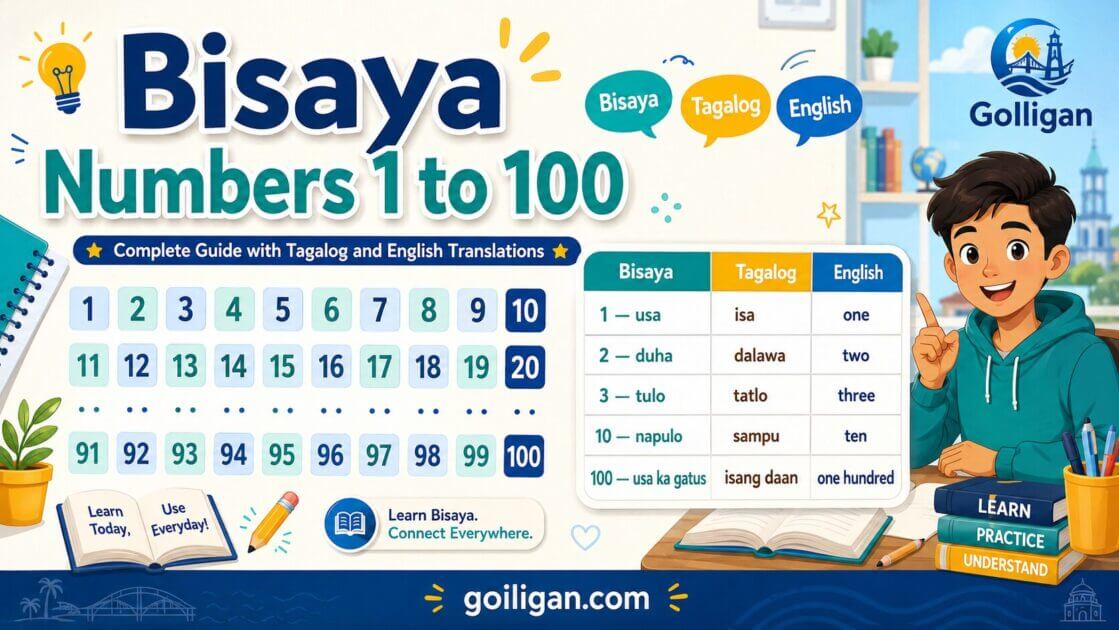
How to Count in Bisaya — Cardinal Numbers, Ordinal Numbers, and Practical Uses in Iligan City and Mindanao
Bisaya numbers use common Cebuano counting words such as usa (one), napulo (ten), kaluhaan (twenty), nubenta (ninety) and usa ka gatos (one hundred). This guide gives Bisaya numbers from 1 to 100 with English and Tagalog equivalents, plus common forms you may hear in Iligan City and across Cebuano-speaking Mindanao.
Explore this topic: Iligan Travel & Logistics Hub
Quick meanings: napulo = ten; nubenta = ninety; siyento = one hundred in Spanish-influenced counting; usa ka gatos = one hundred in native Cebuano construction.
This GoIligan Micro-Guide gives you all Bisaya numbers from 1 to 100, with Tagalog and English translations. You will also find ordinal numbers, practical examples, and common uses you can apply right away in Iligan City and nearby areas.
Why Learn Bisaya Numbers?
Numbers in Bisaya sound different from Tagalog numbers, and knowing them helps you:
- Buy food, items, and pasalubong at local markets without confusion
- Understand prices, change, and amounts when shopping
- Give your age, phone number, or address correctly
- Follow directions that use numbers (floor numbers, street numbers, bus fares)
- Count items, people, or days naturally in conversation
If you already know some Bisaya phrases, adding numbers makes your conversations much more complete. You can also check our guide to 50 Common Bisaya Phrases with Tagalog Meanings for more everyday expressions.
Bisaya Numbers 1 to 10
These are the base numbers. Learn these first — everything else builds on them.
| Number | Bisaya | Tagalog | English |
|---|---|---|---|
| 1 | Usa | Isa | One |
| 2 | Duha | Dalawa | Two |
| 3 | Tulo | Tatlo | Three |
| 4 | Upat | Apat | Four |
| 5 | Lima | Lima | Five |
| 6 | Unom | Anim | Six |
| 7 | Pito | Pito | Seven |
| 8 | Walo | Walo | Eight |
| 9 | Siyam | Siyam | Nine |
| 10 | Napulo | Sampu | Ten |
Quick tip:
Lima (5) is the same in both Bisaya and Tagalog. Pito (7) and Walo (8) are also the same. Usa, Duha, Tulo, Upat, Unom, and Napulo are the ones to memorize carefully.
Bisaya Numbers 11 to 20
Numbers 11 to 19 in Bisaya follow a pattern: the word “napulo ug” (meaning “ten and”) is placed before the base number. This is similar to how Tagalog uses “labing-“.
| Number | Bisaya | Tagalog | English |
|---|---|---|---|
| 11 | Napulo ug usa | Labing-isa | Eleven |
| 12 | Napulo ug duha | Labindalawa | Twelve |
| 13 | Napulo ug tulo | Labintatlo | Thirteen |
| 14 | Napulo ug upat | Labing-apat | Fourteen |
| 15 | Napulo ug lima | Labinlima | Fifteen |
| 16 | Napulo ug unom | Labing-anim | Sixteen |
| 17 | Napulo ug pito | Labimpito | Seventeen |
| 18 | Napulo ug walo | Labingwalo | Eighteen |
| 19 | Napulo ug siyam | Labinsiyam | Nineteen |
| 20 | Baynte / Kawhaan | Dalawampu | Twenty |
Notes on 20:
In everyday Bisaya speech in Iligan and Mindanao, many people use “baynte” (from Spanish) when talking about money or quantities. The traditional Bisaya word is kawhaan. Both are understood.
Bisaya Numbers 21 to 30
| Number | Bisaya | Tagalog | English |
|---|---|---|---|
| 21 | Baynte uno / Kawhaan ug usa | Dalawampu’t isa | Twenty-one |
| 22 | Baynte dos / Kawhaan ug duha | Dalawampu’t dalawa | Twenty-two |
| 23 | Baynte tres / Kawhaan ug tulo | Dalawampu’t tatlo | Twenty-three |
| 24 | Baynte kuwatro | Dalawampu’t apat | Twenty-four |
| 25 | Baynte singko | Dalawampu’t lima | Twenty-five |
| 26 | Baynte seis | Dalawampu’t anim | Twenty-six |
| 27 | Baynte syete | Dalawampu’t pito | Twenty-seven |
| 28 | Baynte otso | Dalawampu’t walo | Twenty-eight |
| 29 | Baynte nuwebe | Dalawampu’t siyam | Twenty-nine |
| 30 | Treynta / Katloan | Tatlumpu | Thirty |
Notes:
Bisaya in daily use — especially for prices, age, and quantities — commonly uses Spanish-derived numbers (baynte, treynta, etc.). The native Bisaya forms (kawhaan, katloan) are still used and understood, especially in formal or traditional contexts.
Bisaya Numbers 31 to 40
| Number | Bisaya | Tagalog | English |
|---|---|---|---|
| 31 | Treynta uno | Tatlumpu’t isa | Thirty-one |
| 32 | Treynta dos | Tatlumpu’t dalawa | Thirty-two |
| 33 | Treynta tres | Tatlumpu’t tatlo | Thirty-three |
| 34 | Treynta kuwatro | Tatlumpu’t apat | Thirty-four |
| 35 | Treynta singko | Tatlumpu’t lima | Thirty-five |
| 36 | Treynta seis | Tatlumpu’t anim | Thirty-six |
| 37 | Treynta syete | Tatlumpu’t pito | Thirty-seven |
| 38 | Treynta otso | Tatlumpu’t walo | Thirty-eight |
| 39 | Treynta nuwebe | Tatlumpu’t siyam | Thirty-nine |
| 40 | Kuwarenta / Kap-atan | Apatnapu | Forty |
Bisaya Numbers 41 to 50
| Number | Bisaya | Tagalog | English |
|---|---|---|---|
| 41 | Kuwarenta uno | Apatnapu’t isa | Forty-one |
| 42 | Kuwarenta dos | Apatnapu’t dalawa | Forty-two |
| 43 | Kuwarenta tres | Apatnapu’t tatlo | Forty-three |
| 44 | Kuwarenta kuwatro | Apatnapu’t apat | Forty-four |
| 45 | Kuwarenta singko | Apatnapu’t lima | Forty-five |
| 46 | Kuwarenta seis | Apatnapu’t anim | Forty-six |
| 47 | Kuwarenta syete | Apatnapu’t pito | Forty-seven |
| 48 | Kuwarenta otso | Apatnapu’t walo | Forty-eight |
| 49 | Kuwarenta nuwebe | Apatnapu’t siyam | Forty-nine |
| 50 | Singkuwenta / Kalim-an | Limampu | Fifty |
Bisaya Numbers 51 to 60
| Number | Bisaya | Tagalog | English |
|---|---|---|---|
| 51 | Singkuwenta uno | Limampu’t isa | Fifty-one |
| 52 | Singkuwenta dos | Limampu’t dalawa | Fifty-two |
| 53 | Singkuwenta tres | Limampu’t tatlo | Fifty-three |
| 54 | Singkuwenta kuwatro | Limampu’t apat | Fifty-four |
| 55 | Singkuwenta singko | Limampu’t lima | Fifty-five |
| 56 | Singkuwenta seis | Limampu’t anim | Fifty-six |
| 57 | Singkuwenta syete | Limampu’t pito | Fifty-seven |
| 58 | Singkuwenta otso | Limampu’t walo | Fifty-eight |
| 59 | Singkuwenta nuwebe | Limampu’t siyam | Fifty-nine |
| 60 | Sesenta / Kan-uman | Animnapu | Sixty |
Bisaya Numbers 61 to 70
| Number | Bisaya | Tagalog | English |
|---|---|---|---|
| 61 | Sesenta uno | Animnapu’t isa | Sixty-one |
| 62 | Sesenta dos | Animnapu’t dalawa | Sixty-two |
| 63 | Sesenta tres | Animnapu’t tatlo | Sixty-three |
| 64 | Sesenta kuwatro | Animnapu’t apat | Sixty-four |
| 65 | Sesenta singko | Animnapu’t lima | Sixty-five |
| 66 | Sesenta seis | Animnapu’t anim | Sixty-six |
| 67 | Sesenta syete | Animnapu’t pito | Sixty-seven |
| 68 | Sesenta otso | Animnapu’t walo | Sixty-eight |
| 69 | Sesenta nuwebe | Animnapu’t siyam | Sixty-nine |
| 70 | Setenta / Pitoan | Pitumpu | Seventy |
Bisaya Numbers 71 to 80
| Number | Bisaya | Tagalog | English |
|---|---|---|---|
| 71 | Setenta uno | Pitumpu’t isa | Seventy-one |
| 72 | Setenta dos | Pitumpu’t dalawa | Seventy-two |
| 73 | Setenta tres | Pitumpu’t tatlo | Seventy-three |
| 74 | Setenta kuwatro | Pitumpu’t apat | Seventy-four |
| 75 | Setenta singko | Pitumpu’t lima | Seventy-five |
| 76 | Setenta seis | Pitumpu’t anim | Seventy-six |
| 77 | Setenta syete | Pitumpu’t pito | Seventy-seven |
| 78 | Setenta otso | Pitumpu’t walo | Seventy-eight |
| 79 | Setenta nuwebe | Pitumpu’t siyam | Seventy-nine |
| 80 | Otsenta / Waloan | Walumpu | Eighty |
Bisaya Numbers 81 to 90
| Number | Bisaya | Tagalog | English |
|---|---|---|---|
| 81 | Otsenta uno | Walumpu’t isa | Eighty-one |
| 82 | Otsenta dos | Walumpu’t dalawa | Eighty-two |
| 83 | Otsenta tres | Walumpu’t tatlo | Eighty-three |
| 84 | Otsenta kuwatro | Walumpu’t apat | Eighty-four |
| 85 | Otsenta singko | Walumpu’t lima | Eighty-five |
| 86 | Otsenta seis | Walumpu’t anim | Eighty-six |
| 87 | Otsenta syete | Walumpu’t pito | Eighty-seven |
| 88 | Otsenta otso | Walumpu’t walo | Eighty-eight |
| 89 | Otsenta nuwebe | Walumpu’t siyam | Eighty-nine |
| 90 | Nubenta / Siyaman | Siyamnapu | Ninety |
Bisaya Numbers 91 to 100
| Number | Bisaya | Tagalog | English |
|---|---|---|---|
| 91 | Nubenta uno | Siyamnapu’t isa | Ninety-one |
| 92 | Nubenta dos | Siyamnapu’t dalawa | Ninety-two |
| 93 | Nubenta tres | Siyamnapu’t tatlo | Ninety-three |
| 94 | Nubenta kuwatro | Siyamnapu’t apat | Ninety-four |
| 95 | Nubenta singko | Siyamnapu’t lima | Ninety-five |
| 96 | Nubenta seis | Siyamnapu’t anim | Ninety-six |
| 97 | Nubenta syete | Siyamnapu’t pito | Ninety-seven |
| 98 | Nubenta otso | Siyamnapu’t walo | Ninety-eight |
| 99 | Nubenta nuwebe | Siyamnapu’t siyam | Ninety-nine |
| 100 | Usa ka gatos / Siyento | Isang daan | One hundred |
The Big Numbers: Beyond 100
| Number | Bisaya | Tagalog | English |
|---|---|---|---|
| 100 | Usa ka gatos / Siyento | Isang daan | One hundred |
| 200 | Duha ka gatos | Dalawang daan | Two hundred |
| 500 | Lima ka gatos | Limang daan | Five hundred |
| 1,000 | Usa ka libo | Isang libo | One thousand |
| 5,000 | Lima ka libo | Limang libo | Five thousand |
| 10,000 | Napulo ka libo | Sampung libo | Ten thousand |
| 100,000 | Usa ka gatos ka libo | Isang daang libo | One hundred thousand |
| 1,000,000 | Usa ka milyon | Isang milyon | One million |
These are useful when dealing with prices, salaries, and bills in Bisaya-speaking areas.
Quick Reference: Bisaya Numbers Cheat Sheet
Here are the key numbers to memorize first for everyday use:
| Bisaya | Tagalog | English |
|---|---|---|
| Usa | Isa | 1 |
| Duha | Dalawa | 2 |
| Tulo | Tatlo | 3 |
| Upat | Apat | 4 |
| Lima | Lima | 5 |
| Napulo | Sampu | 10 |
| Baynte | Dalawampu | 20 |
| Treynta | Tatlumpu | 30 |
| Singkuwenta | Limampu | 50 |
| Usa ka gatos | Isang daan | 100 |
| Usa ka libo | Isang libo | 1,000 |
Ordinal Numbers in Bisaya
Ordinal numbers (first, second, third…) are used to rank things, give order, or describe floors and positions. In Bisaya, ordinal numbers are formed by adding “ika-“ before the number.
| Ordinal | Bisaya | Tagalog | English |
|---|---|---|---|
| 1st | Una / Ikausa | Una | First |
| 2nd | Ikaduha | Ikalawa | Second |
| 3rd | Ikatulo | Ikatlo | Third |
| 4th | Ikaupat | Ikaapat | Fourth |
| 5th | Ikalima | Ikalima | Fifth |
| 6th | Ikaunom | Ikaanim | Sixth |
| 7th | Ikapito | Ikapito | Seventh |
| 8th | Ikawalo | Ikawalo | Eighth |
| 9th | Ikasiyam | Ikasiyam | Ninth |
| 10th | Ikanapulo | Ikasampu | Tenth |
Example:
Bisaya: Ang akong opisina naa sa ikatulo nga palapag. Tagalog: Ang aking opisina ay nasa ikatlong palapag. English: My office is on the third floor.
How Bisaya Numbers Are Used in Everyday Conversation
Asking and Giving Prices
The most common use of numbers in Bisaya is for prices. In markets, stores, and food stalls around Iligan City, you will hear:
“Pila ni?” — How much is this?
Common responses:
| Bisaya | Tagalog | English |
|---|---|---|
| Baynte pesos | Dalawampung piso | Twenty pesos |
| Singkuwenta pesos | Limampung piso | Fifty pesos |
| Usa ka gatos | Isang daan | One hundred pesos |
| Duha ka gatos | Dalawang daan | Two hundred pesos |
| Tulo ka gatos ug singkuwenta | Tatlong daan at limampu | Three fifty |
Telling Your Age
“Pila na imong edad?” — How old are you?
| Answer (Bisaya) | Tagalog | English |
|---|---|---|
| Baynte singko na ko | Dalawampu’t lima na ako | I am 25 |
| Treynta anyos na ko | Tatlumpu na ako | I am 30 |
| Usa ka gatos na siya | Isang daan na siya | She/he is 100 |
Counting Items
| Bisaya | Tagalog | English |
|---|---|---|
| Usa ka piraso | Isang piraso | One piece |
| Duha ka kilo | Dalawang kilo | Two kilos |
| Tulo ka baso | Tatlong baso | Three glasses |
| Lima ka minuto | Limang minuto | Five minutes |
| Napulo ka araw | Sampung araw | Ten days |
Giving Phone Numbers
Phone numbers in Bisaya are typically read digit by digit, the same way as in Tagalog or English. For example, 0915 would be read as “zero, siyam, usa, lima” or in Spanish-influenced Bisaya: “zero, nuwebe, uno, singko.”
Practical Bisaya Number Conversations
At the Market in Iligan
Buyer: Pila ni nga mangga? Tagalog: Magkano itong mangga? English: How much is this mango?
Seller: Treynta pesos usa ka kilo. Tagalog: Tatlumpung piso ang isang kilo. English: Thirty pesos per kilo.
Buyer: Duha ka kilo, palihog. Tagalog: Dalawang kilo, pakiusap. English: Two kilos, please.
Seller: Okay. Ikausa ang total, singkuwenta pesos ra gyud. Tagalog: Okay. Ang total, animnapung piso. English: Okay. The total is sixty pesos.
At a Food Stall
Customer: Tulo ka puso, pila? Tagalog: Tatlong puso, magkano? English: Three orders, how much?
Vendor: Napulo ug lima ang usa, tulo ka puso baynte singko. Tagalog: Labinlima ang isa, tatlo ay dalawampu’t lima. English: Fifteen each, three for twenty-five.
Native Bisaya Number Words vs Spanish-Derived Numbers
One useful thing to understand: Bisaya has two parallel number systems in common use.
| Type | Example (10) | Example (20) | Example (100) |
|---|---|---|---|
| Native Bisaya | Napulo | Kawhaan | Usa ka gatos |
| Spanish-derived | Dyis | Baynte | Siyento |
Which one should you use?
In everyday conversation in Iligan City and Mindanao:
- Spanish-derived numbers are more common for money, age, and measurements
- Native Bisaya numbers are more commonly used for counting objects, people, and general quantities
- Both are understood — no need to worry too much about which system to use
Bisaya Numbers in Context: Iligan City
If you are visiting Iligan City, numbers come up in practical situations:
| Situation | Useful Number Phrase | Bisaya Example |
|---|---|---|
| Bus fare | Asking how much | “Pila ang bayad padulong downtown?” |
| Terminal | Asking departure time | “Unsay oras ang sunod bus?” |
| Market | Asking for price | “Pila ni usa ka kilo?” |
| Hotel | Asking for room number | “Naa ba mog kuwarto sa ikatulo?” |
| Pharmacy | Asking quantity | “Tulo ka kapsula, pila?” |
| Restaurant | Ordering quantity | “Duha ka plato, palihog” |
For more useful local Bisaya expressions, see our guide: 50 Common Bisaya Phrases for Travelers and Visitors to Iligan City.
Frequently Asked Questions About Bisaya Numbers
How do you say “one” in Bisaya?
Usa is one in Bisaya. It is pronounced “oo-sah.” This is different from Tagalog isa, so it is one of the key numbers to memorize.
How do you say “ten” in Bisaya?
Napulo is ten in Bisaya. It is pronounced “nah-poo-lo.” In Spanish-derived Bisaya, you may also hear dyis.
How do you count from 1 to 10 in Bisaya?
One to ten in Bisaya: Usa, Duha, Tulo, Upat, Lima, Unom, Pito, Walo, Siyam, Napulo.
How do you say “how much” in Bisaya?
Pila means “how much” or “how many” in Bisaya. “Pila ni?” (How much is this?) is one of the most useful Bisaya phrases for market shopping and everyday transactions.
What is “ilang” in Bisaya?
“Ilang” is the Tagalog word for “how many.” The Bisaya equivalent is “pila.” So “ilang sa bisaya” essentially means “what is the Bisaya word for a number or quantity.” The answer is pila for how many, and the numbers themselves follow the list above.
Are Bisaya numbers the same as Cebuano numbers?
Yes. Bisaya and Cebuano refer to the same language in most everyday usage. The numbers are the same whether you call the language Bisaya or Cebuano.
Do Bisaya speakers use Spanish numbers for money?
In many cases, yes. Spanish-influenced number words like baynte (20), treynta (30), singkuwenta (50), and siyento (100) are commonly used when talking about prices, money amounts, and ages. Both native Bisaya and Spanish-derived forms are understood.
How do you say “one hundred” in Bisaya?
Usa ka gatos is the native Bisaya for one hundred. Siyento (from Spanish ciento) is also widely used, especially for money.
How do you say “one thousand” in Bisaya?
Usa ka libo means one thousand in Bisaya. You may also hear usa ka mil in some areas.
How do ordinal numbers work in Bisaya?
Ordinal numbers in Bisaya are formed by adding “ika-“ before the number. So ikatulo means third, ikaupat means fourth, and ikanapulo means tenth. The exception is first, which is usually una rather than ikausa.
Summary: Bisaya Numbers at a Glance
| Range | Pattern |
|---|---|
| 1–10 | Unique base words: Usa, Duha, Tulo, Upat, Lima, Unom, Pito, Walo, Siyam, Napulo |
| 11–19 | Napulo ug [base number] — e.g., Napulo ug duha = 12 |
| 20, 30, 40… | Spanish-derived (Baynte, Treynta, Kuwarenta…) or native (Kawhaan, Katloan, Kap-atan…) |
| 21–99 | Tens word + base number — e.g., Baynte singko = 25 |
| 100 | Usa ka gatos / Siyento |
| 1,000 | Usa ka libo |
| Ordinals | Ika- + number — e.g., Ikatulo = third |
More Bisaya Language Guides from GoIligan
Building your Bisaya vocabulary one topic at a time:
- 50 Common Bisaya Phrases with Tagalog Meanings — Greetings, travel phrases, everyday expressions
- Bisaya Words for Emotions — How to express feelings in Bisaya
- Iliganon Words and Bisaya Phrases Every Traveler Should Learn — Local Iligan vocabulary
Final Takeaway
Bisaya numbers are not difficult once you know the base words from 1 to 10. Everything from 11 upward follows a pattern, and Spanish-derived numbers make many everyday quantities easy to recognize.
Start with the basics: Usa, Duha, Tulo, Upat, Lima — and work up from there. The most practical phrases to master first are “Pila ni?” (how much?) and “Baynte, treynta, singkuwenta” for common price ranges you will encounter in Iligan City markets, food stalls, and transport terminals.
Daghang salamat sa pagbasa, and amping!
Editorial Note
Bisaya number usage may vary by area, generation, and context. This guide covers both native Bisaya number words and Spanish-derived forms commonly used in Iligan City, Northern Mindanao, and Bisaya-speaking communities across the Philippines. Numbers are simplified for Tagalog speakers, beginners, and travelers.