
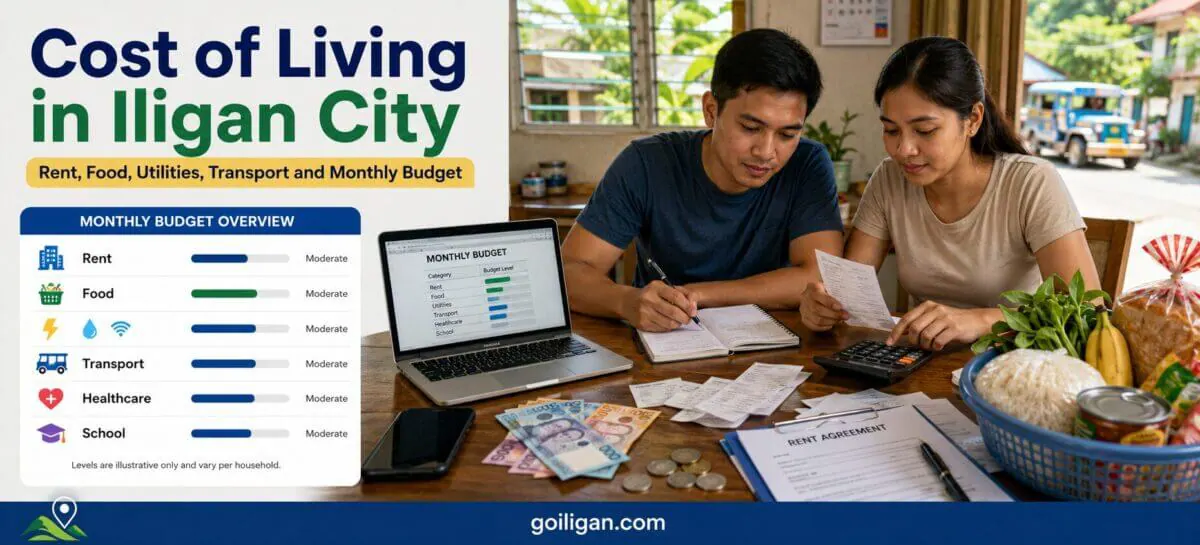
Living in Iligan City can be more affordable than living in Metro Manila, especially for rent, daily food, and short local transport. A single person can plan around ₱18,000 to ₱35,000 per month for a basic to comfortable lifestyle, while a family of four can plan around ₱55,000 to ₱100,000+ per month, depending on rent, school choices, private healthcare use, air-conditioning, and transport habits.
Explore this topic: Iligan City Services & Living Hub
Iligan is officially listed by the Philippine Statistics Authority as a 1st class highly urbanized city in Northern Mindanao, with 44 barangays and a 2024 population count of 368,132. That matters because Iligan has city-level services and urban costs, but its daily expenses can still feel more provincial than Manila or Cebu when you live near work, cook at home, and use local transport.
Quick Cost of Living Snapshot in Iligan City
These are practical planning ranges, not fixed prices. Actual costs depend on barangay, property condition, contract terms, electricity use, school choice, commute distance, and current market prices.
| Expense Category | Budget Range Per Month | Notes |
|---|---|---|
| Room or bedspace | ₱2,500 to ₱6,000 | Common for students, workers, and single renters |
| Studio or small apartment | ₱5,000 to ₱10,000 | Lower-cost units are usually simpler and less central |
| 1-bedroom apartment | ₱7,000 to ₱15,000 | Price depends heavily on location and furnishing |
| 2-bedroom apartment or small house | ₱12,000 to ₱25,000 | Fits couples, small families, or shared renters |
| Larger house | ₱18,000 to ₱40,000+ | Higher if gated, furnished, or near major roads |
| Groceries, single person | ₱6,000 to ₱10,000 | Lower if mostly home-cooked |
| Groceries, family of four | ₱22,000 to ₱40,000 | Higher with meat-heavy meals and branded goods |
| Electricity | ₱1,500 to ₱8,000+ | Air-conditioning is the budget breaker |
| Water | ₱300 to ₱1,200+ | Depends on provider, household size, and usage |
| Internet | ₱1,299 to ₱2,500+ | Fiber plans vary by provider and area availability |
| Local transport | ₱1,500 to ₱6,000 | Depends on daily commute and tricycle use |
| Healthcare allowance | ₱1,000 to ₱8,000+ | Higher for private consultations, labs, and medicines |
| School and childcare | ₱2,000 to ₱20,000+ | Public vs private school makes the big difference |
Good to know: The table above is a budgeting guide. For rent, always verify the current listing, exact address, included utilities, deposit terms, and whether the unit has its own electric and water meters before paying.
Overview of Living Costs in Iligan City
Iligan City sits in Northern Mindanao and functions as an urban center for residents, students, workers, families, and people moving from nearby municipalities. It has a mix of dense urban barangays, residential subdivisions, student areas, older neighborhoods, coastal communities, and upland barangays.
Your total cost depends on four big choices:
- Where you live
- How much you cook at home
- Whether you use air-conditioning daily
- Whether you own a vehicle or commute
A person renting a simple room near work can keep monthly costs low. A family renting a larger house, using air-conditioning, sending children to private school, and driving daily will spend much more.
The local wage context is important. The National Wages and Productivity Commission lists Northern Mindanao minimum wage rates under Wage Order RX-24, with the second tranche reaching ₱485 to ₱500 per day by May 1, 2026. This means many Iligan households budget carefully around rent, food, transport, utilities, and school expenses.
Housing and Accommodation Costs in Iligan City
Housing is the biggest swing factor in Iligan’s cost of living. A basic room can keep monthly expenses manageable. A furnished apartment or larger house can quickly push the budget upward.
Typical Rental Ranges
| Housing Type | Estimated Monthly Rent | Best Fit |
|---|---|---|
| Bedspace | ₱2,500 to ₱4,500 | Students, workers, short-term budget renters |
| Private room | ₱3,500 to ₱6,000 | Single renters who want privacy |
| Studio unit | ₱5,000 to ₱10,000 | Solo professionals or couples |
| 1-bedroom apartment | ₱7,000 to ₱15,000 | Professionals, couples, remote workers |
| 2-bedroom apartment or house | ₱12,000 to ₱25,000 | Small families or shared renters |
| 3-bedroom house | ₱18,000 to ₱40,000+ | Families needing more space |
| Furnished short-term stay | Higher than regular rent | Visitors, temporary workers, digital nomads |
Public rental listings change quickly. One public Iligan rental group listing shown in search results advertised a room for ₱4,500, which is useful as a market signal but should not be treated as a citywide average. Short-term platforms also show furnished rentals, but these are usually priced differently from long-term local leases.
Where Rent Gets Cheaper or More Expensive
Rent is usually affected by:
| Factor | What It Means for Rent |
|---|---|
| Near city center or schools | Higher demand, faster-moving listings |
| Along main roads | Easier commuting, often higher rent |
| Inside subdivisions | Higher rent if security, parking, and larger floor area are included |
| Farther barangays | Lower rent, but transport costs can rise |
| Furnished units | Higher monthly rent, lower move-in cost for furniture |
| Separate meters | Better control over actual utility use |
For budget-conscious renters, the better play is not always the cheapest rent. A cheaper unit far from work can become more expensive after daily transport, tricycle rides, and lost time.
Common Move-In Costs
Many landlords require:
| Requirement | Common Setup |
|---|---|
| Advance rent | 1 month |
| Security deposit | 1 to 2 months |
| Minimum stay | 6 months to 1 year |
| Utility setup | Tenant may pay or transfer account |
| Proof of identity | Valid ID |
| Written agreement | Strongly recommended |
Before paying, ask for a written rental agreement, exact inclusions, refund rules for the deposit, meter arrangement, repair responsibilities, and whether visitors, pets, parking, or home-based work are allowed.
Food and Grocery Expenses in Iligan City
Food costs in Iligan can stay manageable if you cook at home, shop from public markets, and buy fresh produce based on season and availability. Grocery costs rise when you rely on branded items, imported goods, delivery food, convenience stores, and frequent restaurant meals.
Monthly Food Budget by Household Type
| Household Type | Basic Home-Cooked Budget | Comfortable Budget |
|---|---|---|
| Single person | ₱6,000 to ₱8,000 | ₱9,000 to ₱12,000 |
| Couple | ₱12,000 to ₱18,000 | ₱20,000 to ₱28,000 |
| Family of four | ₱22,000 to ₱32,000 | ₱35,000 to ₱50,000+ |
The Philippine Statistics Authority tracks retail prices of agricultural commodities nationwide. In May 2026, PSA reported a national average retail price of ₱9.24 per piece for chicken egg, which gives readers a benchmark for comparing local store and market prices. Local Iligan prices can move above or below national averages depending on supply, store type, and season.
Practical Grocery Basket for Iligan Households
| Item | Budget Note |
|---|---|
| Rice | Buy by sack if the household eats rice daily and has storage space |
| Eggs | Useful low-cost protein, but price changes by size and supply |
| Chicken | Often cheaper than beef for regular meals |
| Fish | Can be affordable depending on type and market timing |
| Vegetables | Buy from public markets for better value |
| Canned goods | Useful for emergencies, but not always cheapest per meal |
| Coffee, milk, bread | Adds up quickly if bought daily from convenience stores |
| Drinking water | Include refill station or bottled water costs in the budget |
Eating Out in Iligan City
| Meal Type | Estimated Cost Per Person |
|---|---|
| Carinderia meal | ₱70 to ₱150 |
| Fast food meal | ₱120 to ₱250 |
| Casual local restaurant | ₱180 to ₱400 |
| Coffee and snack | ₱120 to ₱300 |
| Family restaurant meal | ₱800 to ₱2,000+ per group |
A worker who eats out for lunch every weekday can easily spend ₱2,000 to ₱4,000 per month on weekday lunches alone. Bringing baon, cooking rice at home, or eating at nearby carinderias keeps the budget tighter.
Money-saving move: Shop for vegetables, fish, and meat where turnover is high. Prices are often better when you buy early, compare stalls, and avoid last-minute convenience-store purchases.
Utilities: Electricity, Water, Internet and Mobile Costs
Utilities in Iligan are manageable for small households, but electricity can jump fast when air-conditioning, refrigerators, washing machines, desktop computers, and water heaters are used daily.
Electricity
Iligan Light and Power, Inc. is the local electric distribution utility, and its official website lists customer service and billing-related contact channels. ILPI also posts residential rate advisories, so residents should check the latest advisory when estimating monthly bills.
| Household Setup | Estimated Monthly Electricity |
|---|---|
| Light use, fan only | ₱1,000 to ₱2,500 |
| Small apartment with refrigerator | ₱2,000 to ₱4,000 |
| With regular aircon use | ₱4,000 to ₱8,000+ |
| Family home with multiple appliances | ₱6,000 to ₱12,000+ |
Air-conditioning is usually the largest electricity driver. A small room with a fan-only setup can be dramatically cheaper than a unit using aircon nightly.
Water
Water costs depend on provider, household size, meter setup, and whether the unit has its own connection. Renters should ask whether water is individually metered, sub-metered, shared, or included in rent.
| Household Type | Estimated Monthly Water |
|---|---|
| Single renter | ₱200 to ₱500 |
| Couple | ₱300 to ₱800 |
| Family | ₱600 to ₱1,500+ |
Internet and Mobile Data
For remote workers, students, and families with streaming needs, internet should be treated as a core monthly expense.
| Service | Estimated Monthly Cost |
|---|---|
| Mobile prepaid data | ₱300 to ₱1,500 |
| Home fiber internet | ₱1,299 to ₱2,500+ |
| Backup prepaid Wi-Fi | ₱500 to ₱1,500 |
| Pocket Wi-Fi or router backup | Device cost plus data load |
Before renting, test mobile signal inside the unit. Do not rely only on the signal outside the building. Thick walls, inner rooms, and lower-floor units can weaken mobile data.
Transportation and Commuting Costs
Daily transport in Iligan is cheaper when you live close to work, school, or the city center. Costs rise when your route requires multiple rides or regular tricycle trips.
Local Transport Budget
| Commuter Type | Estimated Monthly Transport |
|---|---|
| Walks or rides occasionally | ₱500 to ₱1,500 |
| Daily short commute | ₱1,500 to ₱3,500 |
| Multiple rides per day | ₱3,500 to ₱6,000 |
| Frequent tricycle use | ₱4,000 to ₱8,000+ |
Jeepneys and tricycles are common daily transport options. Exact fares depend on route, distance, current fare rules, and local franchise arrangements, so commuters should check posted fare matrices and ask before boarding unfamiliar routes.
Motorcycle Ownership
A motorcycle can be practical in Iligan, especially for people living outside the city center. It also adds recurring costs.
| Motorcycle Cost | Estimated Range |
|---|---|
| Fuel | ₱1,500 to ₱4,000 per month |
| Parking | ₱0 to ₱1,500 per month |
| Basic maintenance | ₱500 to ₱2,000 per month average |
| Registration and insurance | Annual cost, budget monthly |
| Helmet, rain gear, repairs | Set aside emergency fund |
The Department of Energy publishes fuel price monitoring and Mindanao pump price updates. Drivers should check the latest DOE fuel monitoring page because gasoline and diesel prices can move quickly.
Travel to Cagayan de Oro and Nearby Cities
Iligan residents often travel to Cagayan de Oro for flights, shopping, business, medical appointments, or errands. Budget for bus fares, terminal transport, meals, and return travel.
| Trip Type | Budget Note |
|---|---|
| Iligan to Cagayan de Oro | Prepare for round-trip fare plus local transport |
| Iligan to Laguindingan Airport | Add allowance for airport transfer or van |
| Iligan to nearby municipalities | Costs vary by route and operator |
| Private car trip | Fuel, parking, tolls if applicable, and vehicle wear |
For frequent intercity travel, living near accessible roads and transport terminals can reduce friction more than saving a small amount on rent.
Healthcare and Medical Expenses
Healthcare costs vary widely depending on whether you use public services, private clinics, private hospitals, laboratories, maintenance medicines, or specialist care.
Healthcare Budget Ranges
| Healthcare Need | Estimated Cost |
|---|---|
| Basic medicine allowance | ₱500 to ₱2,000 per month |
| Private clinic consultation | ₱400 to ₱1,500+ per visit |
| Specialist consultation | ₱800 to ₱2,500+ per visit |
| Basic lab tests | ₱300 to ₱3,000+ |
| Emergency fund | ₱10,000 to ₱50,000+ recommended |
PhilHealth remains a major healthcare support system for Filipino households. For 2026, PhilHealth set the premium contribution rate at 5%, with the amount based on monthly income and salary floor or ceiling rules.
Public vs Private Healthcare Planning
| Option | Budget Impact |
|---|---|
| Public facility | Lower direct cost, longer waiting time possible |
| Private clinic | Faster access for many outpatient concerns |
| Private hospital | Higher out-of-pocket cost |
| HMO or private insurance | Monthly premium, lower surprise costs if covered |
| PhilHealth | Helps with covered cases, not a substitute for cash emergency fund |
For families, build a monthly medicine and checkup line item even when everyone is healthy. The budget gets bruised when checkups, lab work, dental care, and medicine all arrive in the same month.
Education and Childcare Costs
Education is one of the largest family budget differences in Iligan. Public school can keep costs low, but families still spend on transportation, uniforms, supplies, projects, food, gadgets, and internet. Private school increases monthly and annual expenses.
School Budget by Type
| Schooling Type | Estimated Cost Pattern |
|---|---|
| Public elementary or high school | Lower tuition cost, still budget for supplies and transport |
| Private basic education | Tuition, fees, uniforms, books, projects |
| College or university | Tuition depends on institution and program |
| Tutorial or review center | Added monthly cost |
| Childcare | Depends on age, schedule, and provider |
Family Education Costs to Include
| Expense | Budget Note |
|---|---|
| Uniforms | Higher at the start of school year |
| Shoes and bags | Annual or semi-annual expense |
| Books and supplies | Heavy during enrollment period |
| Daily baon | Small daily cost, big monthly total |
| School transport | Higher if the school is far from home |
| Projects and activities | Keep a buffer every month |
| Internet and gadgets | Now part of schooling for many families |
A family choosing where to rent should include school commute in the decision. Saving ₱2,000 on rent is less useful if the children need multiple rides daily.
Entertainment, Leisure and Lifestyle Expenses
Lifestyle spending is flexible, but it has a sneaky little wallet-goblin effect. Coffee, snacks, small online orders, streaming subscriptions, and weekend meals can quietly grow into a major category.
Monthly Lifestyle Budget
| Lifestyle Item | Estimated Cost |
|---|---|
| Gym membership | ₱800 to ₱2,500+ |
| Coffee or milk tea habit | ₱1,000 to ₱4,000+ |
| Streaming subscriptions | ₱149 to ₱1,000+ |
| Casual dining | ₱2,000 to ₱8,000+ |
| Clothing and personal care | ₱1,000 to ₱5,000+ |
| Weekend leisure | ₱1,500 to ₱8,000+ |
Iligan also has natural attractions, waterfalls, spring pools, cafés, local food spots, and nearby day-trip options. These can be affordable if planned well, but transport, food, entrance fees, and group contributions should still be budgeted.
Monthly Budget Examples for Iligan City
These sample budgets are planning models. Adjust them based on your rent, commute, electricity use, family size, school costs, health needs, and lifestyle.
Sample Budget 1: Single Worker, Basic Lifestyle
| Expense | Monthly Budget |
|---|---|
| Room or small shared rental | ₱4,500 |
| Food and groceries | ₱7,000 |
| Electricity and water share | ₱1,500 |
| Mobile data or internet share | ₱800 |
| Transport | ₱2,500 |
| Laundry and personal care | ₱1,500 |
| Healthcare and medicine | ₱1,000 |
| Miscellaneous | ₱2,000 |
| Estimated Total | ₱20,800 |
This works best for someone living close to work, cooking simple meals, and avoiding frequent delivery food.
Sample Budget 2: Single Professional, Comfortable Lifestyle
| Expense | Monthly Budget |
|---|---|
| Studio or 1-bedroom rental | ₱10,000 |
| Food and groceries | ₱10,000 |
| Electricity and water | ₱3,500 |
| Internet and mobile | ₱2,000 |
| Transport | ₱3,500 |
| Eating out and coffee | ₱4,000 |
| Healthcare and fitness | ₱2,500 |
| Savings or emergency fund | ₱5,000 |
| Miscellaneous | ₱3,000 |
| Estimated Total | ₱43,500 |
This fits remote workers, professionals, or people who want privacy, stable internet, and a better daily cushion.
Sample Budget 3: Couple Renting an Apartment
| Expense | Monthly Budget |
|---|---|
| 1-bedroom or 2-bedroom rental | ₱15,000 |
| Groceries | ₱18,000 |
| Electricity and water | ₱5,000 |
| Internet and mobile | ₱2,500 |
| Transport | ₱5,000 |
| Eating out | ₱5,000 |
| Healthcare | ₱3,000 |
| Household items | ₱3,000 |
| Savings or emergency fund | ₱8,000 |
| Estimated Total | ₱64,500 |
A couple can save more by sharing rent and utilities, but food, transport, and lifestyle choices still decide the final number.
Sample Budget 4: Family of Four
| Expense | Monthly Budget |
|---|---|
| 2-bedroom or 3-bedroom rental | ₱22,000 |
| Groceries | ₱35,000 |
| Electricity and water | ₱8,000 |
| Internet and mobile | ₱3,500 |
| Transport | ₱8,000 |
| School costs | ₱10,000 |
| Healthcare and medicine | ₱5,000 |
| Household supplies | ₱4,000 |
| Clothing, activities, misc. | ₱7,000 |
| Savings or emergency fund | ₱10,000 |
| Estimated Total | ₱112,500 |
A family can reduce this by choosing public school, living closer to school and work, limiting aircon use, cooking at home, and avoiding high-interest installment purchases.
Is Iligan City Cheaper Than Manila?
Yes, Iligan City can be cheaper than Manila for rent, local transport, and some daily living costs. The biggest savings usually come from housing. A renter who does not need to live in a premium area can often find lower-cost accommodation than comparable urban rentals in Metro Manila.
The tradeoff is income. Manila has more high-paying corporate roles, multinational employers, and specialized industries. Iligan can be cheaper, but income opportunities can also be narrower depending on your field.
Iligan City vs Cagayan de Oro
Cagayan de Oro has more malls, offices, hospitals, universities, and regional services. That can mean more options, but also more urban pricing pressure in high-demand areas.
Iligan can be a better fit for people who want lower rent, a slower daily rhythm, access to local schools and services, and manageable commutes. CDO can be better for people who need more job options, frequent flights, bigger shopping choices, and more specialized services.
How to Save Money While Living in Iligan City
Choose Location Before Choosing Rent
A cheaper rental far from work can become expensive when you add tricycle rides, fuel, and time. Calculate rent plus transport before deciding.
Check the Electric Meter
Ask whether the unit has a separate meter. Shared or sub-metered electricity can create disputes and surprise bills.
Cook Most Weekday Meals
Eating out is fine, but daily restaurant meals can double your food budget. A rice cooker, basic groceries, and planned meals make a huge difference.
Build a Health Buffer
Even healthy households need money for medicine, dental care, lab tests, and checkups. Keep a small health fund separate from general savings.
Avoid Lifestyle Creep
Coffee, snacks, delivery fees, online shopping, and subscriptions are not evil. They just need a leash.
Verify Rent Before Paying
Do not send deposits without seeing the unit, confirming the person authorized to rent it, checking the exact address, and getting written terms.
Frequently Asked Questions
Is Iligan City expensive to live in?
Iligan City is not expensive compared with Metro Manila, but it is still an urban city with real costs for rent, utilities, food, school, healthcare, and transport. A single renter can live modestly on around ₱18,000 to ₱25,000 per month, but a more comfortable lifestyle needs a larger budget.
How much money do you need to live comfortably in Iligan City?
A single person should plan around ₱30,000 to ₱45,000 per month for a comfortable lifestyle with private rent, internet, utilities, food, transport, and some leisure. A family of four should plan around ₱70,000 to ₱100,000+ per month, especially with private school, air-conditioning, and regular healthcare expenses.
Is Iligan City cheaper than Manila?
Yes. Iligan is usually cheaper than Manila for rent and daily local movement. Manila can offer higher-paying work and more specialized services, so the best choice depends on income, family needs, and lifestyle.
What is the average salary in Iligan City?
There is no single official average salary for all workers in Iligan City. For wage context, Northern Mindanao minimum wage rates reached ₱485 to ₱500 per day by May 1, 2026 under the NWPC wage order. Actual salaries depend on industry, experience, employer, and job type.
Is Iligan a first class city?
Yes. The Philippine Statistics Authority lists the City of Iligan as a 1st class highly urbanized city.
Is Iligan City urban or rural?
Iligan City is a highly urbanized city, but its 44 barangays include both urban and rural classifications. This is why costs can vary strongly between central barangays, residential areas, and farther communities.
What are the cheapest areas to live in Iligan City?
The cheapest areas are usually farther from major commercial roads, schools, and high-demand residential zones. Renters should compare total cost, not rent alone. A low-rent unit can become expensive if daily commuting requires multiple rides.
How much does rent cost in Iligan City?
A room or bedspace can start around ₱2,500 to ₱6,000 per month, while apartments commonly range from around ₱5,000 to ₱25,000 depending on size, location, condition, and furnishing. Larger homes and furnished units can cost more.
Final Budget Advice
For Iligan City, the smartest monthly budget is not the cheapest number on paper. It is the budget that survives real life: rent, food, electricity, water, internet, commute, medicines, school needs, and a small emergency fund.
A good starting target is:
| Household | Practical Monthly Target |
|---|---|
| Single, basic | ₱18,000 to ₱25,000 |
| Single, comfortable | ₱30,000 to ₱45,000 |
| Couple | ₱40,000 to ₱70,000 |
| Family of four | ₱70,000 to ₱100,000+ |
Before moving, confirm the current rental price, utility setup, internet availability, commute route, school distance, and nearby grocery options. Those five details decide whether Iligan feels affordable or quietly expensive.