
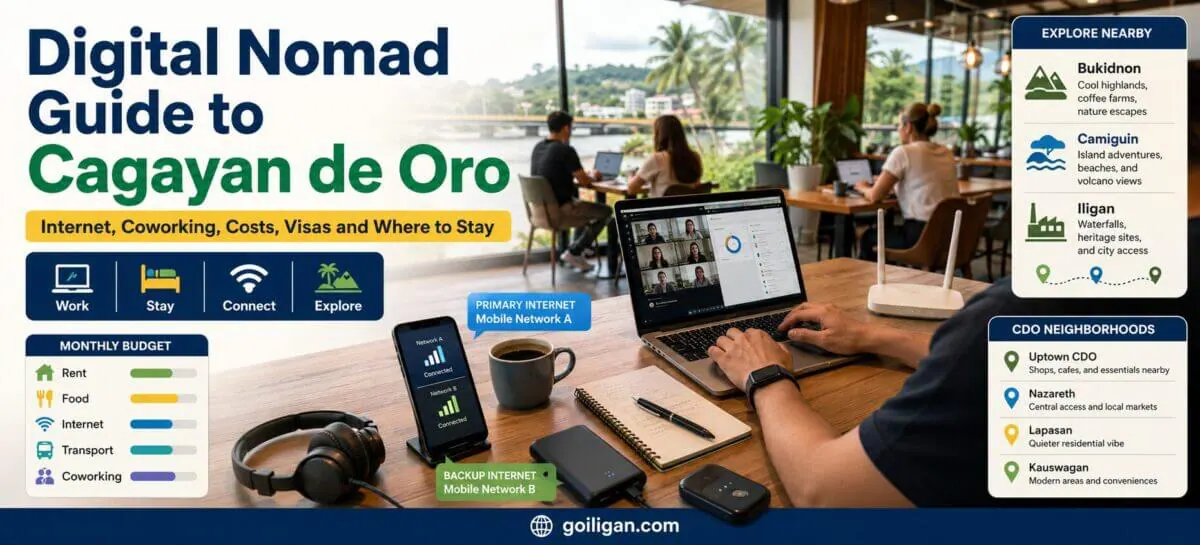
Digital Nomad Guide to Cagayan de Oro
Cagayan de Oro is a practical base for digital nomads who want a large Mindanao city, access to fiber and mobile data, several coworking options, a functioning commercial center and lower day-to-day costs than the Philippines’ largest metropolitan areas. The strongest setup is an apartment with installed fiber, backup mobile data from a second network and access to a coworking space for outages or important calls.
Explore this topic: Mindanao Guides Hub
CDO is best suited to remote workers who value city infrastructure and regional access over a beach-at-the-door lifestyle. It gives you malls, hospitals, restaurants, airport access and road connections to Bukidnon, Camiguin, Iligan and other parts of Northern Mindanao.
Important: Internet performance, rental rates, coworking prices and operating hours change. Confirm the exact address, fiber availability, signal strength and current rate before paying a deposit or committing to a long stay.
Cagayan de Oro at a Glance for Remote Workers
| Category | What to Expect |
|---|---|
| Best overall areas | Uptown CDO, Nazareth, Lapasan and selected parts of Kauswagan |
| Internet strategy | Fixed fiber plus mobile-data backup |
| Workspaces | Coworking hubs, study lounges, cafés and serviced offices |
| Airport | Laguindingan Airport, reached by road from CDO |
| Local language | Cebuano or Bisaya is widely used; Filipino and English are also understood |
| Visa support | Bureau of Immigration Cagayan de Oro District Office in Limketkai Center |
| Best fit | Freelancers, online employees, consultants, creators and founders |
| Main caution | Do not rent based on neighborhood name alone. Test the exact building’s internet and mobile signal. |
The city had a 2024 population of about 742,000, according to the Philippine Statistics Authority. This scale helps explain why CDO supports large malls, universities, medical facilities, BPO operations, restaurants and a wider range of services than smaller provincial destinations.
Why CDO Works for Digital Nomads
CDO occupies a useful middle ground. It has enough urban infrastructure for daily remote work without the scale, congestion and housing pressure associated with Metro Manila. It also functions as a regional gateway, which makes weekend travel easier without requiring a flight for every trip.
The city is useful for remote workers who need:
- Multiple residential districts instead of one concentrated tourist zone
- Fiber internet options in established developments
- Mobile data coverage from major Philippine networks
- Coworking spaces that operate beyond standard office hours
- Malls, groceries, clinics, hospitals and delivery services
- Access to Laguindingan Airport
- Road connections to Bukidnon, Iligan, Misamis Oriental and Camiguin ferry gateways
CDO is not a resort town. That is part of its advantage for some nomads. Daily life revolves around actual neighborhoods, business districts, schools and commercial centers. It is easier to build a routine that feels residential instead of temporary.
CDO’s Weather Advantage Requires Context
Cagayan de Oro is outside the eastern seaboard that receives the first impact of many Pacific tropical cyclones. That does not make the city typhoon-proof or flood-proof. PAGASA maintains a dedicated Cagayan de Oro River Basin monitoring system, and government information notes that the basin has experienced serious flooding.
For remote work, the practical lesson is simple: ask about flood history, drainage, building elevation and backup power before signing a lease. A location that looks central on a map can still have a very different risk profile from another building a few streets away.
Internet Connectivity in Cagayan de Oro
Internet quality in CDO depends on the provider, building wiring, plan, congestion, Wi-Fi equipment and exact location. Citywide averages cannot guarantee the performance of a particular condominium, subdivision, boarding house or apartment.
A strong digital-nomad setup uses three layers:
- Primary connection: Installed fiber at the apartment or condominium
- Secondary connection: Mobile data from a different network
- Emergency workspace: A coworking space or café with power outlets and its own connection
The Philippines’ national internet performance has improved, but neighborhood and building-level differences remain important. A landlord saying “fiber is available” does not prove that your unit has an active line or an open installation slot.
Internet Questions to Ask Before Renting
Ask the owner or property manager for:
- The installed internet provider
- The exact subscribed plan
- A recent speed test from inside the unit
- Upload speed, not download speed alone
- Router location
- Whether the account is included in rent
- Whether the line is shared with other units
- Whether another fiber provider services the building
- Mobile signal strength inside the bedroom and work area
- The building’s power-outage history
- Generator coverage for elevators, sockets and unit power
A screenshot showing 300 Mbps in the lobby is not enough. Test where you will actually sit during calls.
How Much Speed Do You Need?
A stable 25 Mbps connection can support ordinary browsing, cloud tools and video calls for one person. Remote workers handling large video files, live streaming, cloud backups or multiple simultaneous calls should prioritize higher upload speeds and low packet loss.
The more important test is stability during your actual working hours. A fast connection at 10:00 a.m. can behave differently at 8:00 p.m. Run repeated tests and conduct a real video call before committing to a long lease.
Coworking Spaces and Study Hubs in CDO
Cagayan de Oro has a growing mix of coworking spaces, study hubs and flexible offices. Public pages currently identify options such as Nexus Space, SmartWork CDO, Brainwave Coworking Space, Workee and Regus.
| Workspace | Area or Public Location Reference | Publicly Listed Feature | Best For |
|---|---|---|---|
| Nexus Space | Cagayan de Oro | Hourly access and extended daily operations | Flexible short work sessions |
| SmartWork CDO | Nazareth | Public profile lists 24/7 access | Night-shift remote workers |
| Brainwave Coworking Space | Uptown CDO | Daily operations into late evening | Uptown residents |
| Workee | Primavera City area | Public page promotes round-the-clock operation | Late calls and backup workspace |
| Regus | Cagayan de Oro | Coworking and flexible office products | Client meetings and business use |
Nexus Space
Nexus Space publicly describes itself as a place to study, work, meet and create. Its public page has listed hourly access and long operating hours. This makes it relevant for nomads who need a temporary desk without buying a monthly membership.
Confirm the latest hourly price, room price, access rules and Wi-Fi policy before visiting.
SmartWork CDO
SmartWork CDO’s public profile identifies its Nazareth location and advertises 24/7 operation. That schedule is useful for remote workers aligned with European or North American time zones.
Before choosing it for a critical call, ask about private-room availability, background noise, reservation rules and backup power.
Brainwave Coworking Space
Brainwave Coworking Space positions itself as an Uptown CDO work and study location. Its public profile lists daily operating hours extending to midnight. It is a practical backup option for nomads staying around Pueblo de Oro, Upper Carmen and nearby uptown developments.
Workee
Workee’s public page promotes a 24/7 coworking setup with Wi-Fi, private rooms and coffee. Its location in the Primavera City area makes it relevant to remote workers based in Uptown CDO.
Confirm whether private rooms require advance booking and whether overnight access applies every day.
Regus
Regus lists coworking options in Cagayan de Oro. This category fits remote workers who need a more formal office environment, recurring workspace, meeting rooms or business services.
Regus pricing is quote-based. Confirm the specific location, contract terms, access hours and inclusions directly.
Coworking Checklist
Before buying a day pass or membership, check:
- Upload speed and latency
- Backup connection
- Generator or power backup
- Number of accessible sockets
- Call booth or private-room policy
- Food and drink rules
- Air-conditioning hours
- Overnight safety and entry procedures
- Parking
- Noise level during your shift
- Reservation and cancellation terms
Best Areas to Stay in Cagayan de Oro
No single neighborhood is best for every digital nomad. Choose according to work schedule, transport, preferred environment and the exact building’s connectivity.
Uptown CDO
Uptown CDO, including developments around Pueblo de Oro and Upper Carmen, fits nomads who prefer newer residential projects, malls, supermarkets and a less compressed urban environment.
Good for: Longer stays, condominium living, remote workers who spend most weekdays at home and people who prefer an uptown residential base.
Check before renting: Transport after dark, distance from downtown meetings, fiber installation status and mobile signal inside the building.
Nazareth
Nazareth is close to central CDO and contains a dense mix of residential streets, food businesses, schools, study hubs and local services. It can work well for nomads who want a neighborhood feel without moving far from the city center.
Good for: Walkable daily routines, access to local food, central positioning and late-night workspaces.
Check before renting: Street noise, parking, drainage and whether the unit shares internet with other tenants.
Lapasan and Limketkai Area
Lapasan places you near Limketkai Center and major commercial facilities. The Bureau of Immigration Cagayan de Oro District Office is listed at Gateway Tower in Limketkai Center, which is useful for foreign visitors handling immigration transactions.
Good for: Short stays, access to malls and services, immigration errands and people who prefer a commercial district.
Check before renting: Traffic noise, construction, building rules and actual walking conditions between your accommodation and regular destinations.
Downtown and Divisoria
Downtown CDO provides access to government offices, local businesses, transport routes, restaurants and older commercial streets. Accommodation can be practical for shorter stays and for people who want to remain near the traditional city center.
Good for: Urban access, errands, budget-focused stays and travelers without a car.
Check before renting: Building age, room ventilation, noise, internet wiring and late-night street conditions.
Kauswagan
Kauswagan has residential areas, commercial strips and access toward the western side of the city. It can suit nomads who find a well-connected apartment near their regular route.
Good for: Residential living and access toward Bulua, Laguindingan-bound transport routes and western CDO.
Check before renting: Exact distance to groceries, transport availability and flood history.
Finding Digital-Nomad-Friendly Accommodation
CDO accommodation ranges from hotel rooms and serviced units to condominiums, apartments, boarding houses and rooms in shared homes. The property type matters less than the work setup.
A suitable unit should provide:
- A desk or enough room to add one
- An ergonomic chair or permission to bring one
- Fiber already installed
- Strong mobile signal indoors
- Several electrical outlets
- Air-conditioning or adequate ventilation
- A quiet sleeping area
- Water reliability
- Secure entry
- Written rent, deposit and utility terms
- Easy access to food, groceries and transport
Do Not Pay a Long Deposit Before Testing
Book a hotel, hostel or short-term rental for your first several nights. Use that time to inspect units in person.
During inspection:
- Run speed tests in the work area.
- Test two mobile networks.
- Make a video call.
- Check noise with windows open and closed.
- Ask how electricity and water are billed.
- Confirm whether the internet account remains active after move-in.
- Inspect the area at the time you will return from work or dinner.
- Ask for a written inventory and payment receipt.
Listings can disappear, rates change and photos age quickly. Treat any online listing as a lead, not final proof.
Cost of Living for Digital Nomads in CDO
There is no official monthly “digital nomad cost” for Cagayan de Oro. Your budget depends on accommodation, air-conditioning use, imported food, nightlife, transport and how often you work from paid spaces.
The following ranges are planning estimates, not fixed city rates:
| Lifestyle | Indicative Monthly Budget | Typical Pattern |
|---|---|---|
| Lean | ₱35,000 to ₱50,000 | Simple room or apartment, local meals, public transport, limited paid workspace |
| Comfortable | ₱55,000 to ₱85,000 | Private unit, regular air-conditioning, mixed dining, ride-hailing and coworking |
| Higher-comfort | ₱90,000 and above | Newer condominium, frequent restaurants, private transport, travel and premium workspaces |
Suggested Budget Categories
| Category | Lean Planning Range | Comfortable Planning Range |
|---|---|---|
| Rent | ₱10,000 to ₱18,000 | ₱20,000 to ₱35,000+ |
| Electricity and water | ₱3,000 to ₱6,000 | ₱5,000 to ₱10,000+ |
| Internet and mobile data | ₱1,500 to ₱3,000 | ₱2,500 to ₱5,000 |
| Food | ₱10,000 to ₱18,000 | ₱18,000 to ₱30,000 |
| Local transport | ₱2,000 to ₱5,000 | ₱5,000 to ₱12,000 |
| Coworking and cafés | ₱1,000 to ₱4,000 | ₱4,000 to ₱10,000 |
| Health, leisure and miscellaneous | ₱5,000 to ₱10,000 | ₱8,000 to ₱20,000+ |
Air-conditioning is one of the biggest swing factors. A poorly insulated unit used around the clock can produce a much larger electricity bill than a smaller room used mainly at night.
Imported groceries, specialty diets and frequent Western-style dining also change the calculation quickly.
Visa Requirements and Legal Considerations
Foreign nationals should separate three questions:
- Are you allowed to enter and stay in the Philippines?
- Does your immigration status permit your intended remote-work arrangement?
- Do tax or business obligations apply to your circumstances?
Tourist Entry and Extensions
The Bureau of Immigration states that eligible non-visa-required tourists can receive an initial 30-day admission and apply for a 29-day visa waiver. Further temporary-visitor extensions are handled under separate procedures.
The Bureau of Immigration also operates online eServices for tourist visa extensions and visa waivers. Eligibility, available transaction types and documentary requirements should be checked directly before applying.
The Cagayan de Oro Immigration District Office is officially listed at:
2nd Floor, Gateway Tower, Limketkai Center, Lapasan, Cagayan de Oro City 9000
The Bureau of Immigration directory lists office hours, an official email address and a direct telephone line. Confirm the transaction you need before visiting because not every field office processes every immigration service.
Philippine Digital Nomad Visa
Executive Order No. 86, signed in 2025, authorized the Department of Foreign Affairs to issue Digital Nomad Visas to qualified non-immigrant foreigners working remotely for employers or clients outside the Philippines.
The order describes core eligibility conditions, including:
- Applicant must be at least 18 years old
- Proof of remote work using digital technology
- Sufficient income generated outside the Philippines
- No criminal record
- Health insurance valid in the Philippines
- No employment in the Philippines
- Nationality from a country that offers a reciprocal digital-nomad arrangement to Filipinos
- No threat to Philippine security
The visa framework allows a stay of up to one year, renewable for another year under the order’s conditions. Applicants should verify whether applications are currently accepted in their country and obtain the latest DFA instructions. Do not rely on private websites that publish unofficial income thresholds or guaranteed approval claims.
Can You Work Remotely on a Tourist Visa?
A tourist visa is designed for temporary visitors. Executive Order No. 86 created a separate framework specifically for digital nomads working for overseas employers or clients.
Remote workers should obtain guidance from the Bureau of Immigration, the Department of Foreign Affairs or a qualified Philippine immigration professional before treating tourist status as work authorization. This is particularly important for long stays, Philippine clients, locally sourced income, hiring local staff or establishing a business.
Special Resident Retiree’s Visa
The Special Resident Retiree’s Visa (SRRV) is a separate long-term option administered through the Philippine Retirement Authority. The current PRA program includes age, deposit, pension and documentary requirements that differ by SRRV category.
The SRRV is relevant to qualifying older remote workers planning an indefinite stay. It should not be treated as a substitute for checking employment, tax or business rules.
SIM Cards, Banking and Payments
Philippine SIM cards require registration. Bring a valid passport and follow the mobile network’s official registration procedure. Purchase the SIM from an official store or recognized retailer, then confirm that calls, texts, data and hotspot functions work.
For redundancy, use SIMs from two different network operators. Signal quality can differ inside the same building.
Foreign visitors can use international cards, cash and Philippine e-wallets where eligible. Opening a local bank account depends on the bank’s current identification, address, immigration and compliance requirements. Visit the bank with your passport and immigration documents, and ask for the exact requirements for your status.
Keep more than one payment method. Card terminals, online banking, ATMs and e-wallets can each experience temporary outages.
Safety and Health
CDO is a large city, so safety varies by street, time and activity. Use the same urban habits you would apply elsewhere:
- Do not display expensive equipment unnecessarily
- Use secure transport after late shifts
- Keep passport copies separate from the original
- Avoid leaving laptops unattended in cafés
- Confirm the identity of landlords and agents
- Use written rental agreements
- Store emergency funds in more than one place
- Check weather and flood advisories during heavy rain
- Use registered transport services where available
Do not describe any entire neighborhood as “safe” based on reputation alone. Inspect the exact block, entry route, lighting and late-night transport situation.
For healthcare, choose accommodation within practical reach of a hospital or clinic, especially when managing a chronic condition. Carry health insurance details, medicine records and emergency contacts.
Community, Networking and Social Life
CDO’s community is broader than a formal digital-nomad scene. Remote workers can connect through:
- Coworking spaces and study hubs
- Startup and technology events
- Chamber and business events
- University-linked activities
- Fitness communities
- Volunteer organizations
- Local Facebook groups
- Language exchanges
- Outdoor and travel groups
The fastest way to build a local circle is to return to the same workspace, gym, café or activity every week. CDO is a working city, so consistent participation tends to be more useful than waiting for a nomad-specific meetup.
Language
Cebuano, commonly called Bisaya, is widely spoken. Filipino and English are also used.
Useful phrases include:
- Maayong buntag: Good morning
- Salamat: Thank you
- Palihog: Please
- Tagpila?: How much?
- Asa ang…?: Where is…?
- Pwede mangutana?: May I ask?
- Wala ko kasabot: I do not understand
- Hinay-hinay lang: Please speak slowly
Trying a few Cebuano phrases makes everyday interactions warmer and easier.
Weekend Trips from CDO
Cagayan de Oro works well as a regional launch point. Common trip directions include:
- Bukidnon for highland scenery, food stops and outdoor activities
- Camiguin through the Balingoan ferry route
- Iligan City for waterfalls, food and urban day trips
- Misamis Oriental coastal municipalities
- Whitewater rafting and river-based activities around CDO
- Claveria and other upland areas of Misamis Oriental
Travel times depend on traffic, road conditions, transfer timing and weather. Build buffer time into airport and ferry connections.
First-Week Checklist for a Digital Nomad in CDO
Before Arrival
- Confirm passport validity and immigration requirements
- Purchase travel or health insurance
- Reserve short-term accommodation
- Save offline copies of bookings and identification
- Bring universal adapters, a power bank and backup authentication codes
- Tell your bank that you will use cards in the Philippines
During the First 48 Hours
- Register your SIM
- Test two mobile networks
- Locate the nearest grocery, pharmacy and clinic
- Identify two backup workspaces
- Test ride-hailing and local transport options
- Check weather and flood information
- Withdraw a small amount of cash from a secure ATM
Before Signing a Lease
- Inspect the property
- Verify the owner or authorized agent
- Read the contract
- Confirm deposit and refund terms
- Photograph the unit
- Test internet and mobile data
- Ask about water and electricity billing
- Check noise during your actual sleep hours
- Ask about visitors, pets and home-office restrictions
- Obtain receipts for every payment
Common Mistakes to Avoid
Choosing a Unit Based on Photos
Interior photos tell you little about upload speed, street noise, drainage, security or commute time.
Depending on One Internet Provider
A second mobile network and a coworking backup are essential for deadline-sensitive work.
Assuming “Uptown” or “Downtown” Guarantees Quality
Building management and exact street conditions matter more than the district label.
Treating a Tourist Stay as Automatic Remote-Work Permission
Immigration status, work activity and tax exposure are separate issues. Verify each one.
Paying Several Months in Advance Without Documentation
Use a written agreement, confirm who owns or manages the property and collect receipts.
Booking a Flight Too Close to a Work Deadline
Laguindingan Airport requires a road transfer. Add time for traffic, weather, check-in and transport delays.
Is Cagayan de Oro Right for You?
CDO is a strong choice when you want a functional regional city, year-round services, several residential districts and access to the rest of Northern Mindanao. It fits remote workers who are comfortable building their own routine instead of entering an established resort-style nomad bubble.
Choose CDO when your priorities are:
- Urban infrastructure
- Lower-cost planning than the largest Philippine metros
- Airport and regional road access
- Local food and everyday city life
- Coworking and late-shift workspace options
- Weekend access to mountains, islands, rivers and nearby cities
Choose another destination when you require:
- A large, organized international digital-nomad community
- Beach access within walking distance
- Extensive public transport comparable to a major capital
- Guaranteed building-level internet without personal testing
The deciding factor is not whether CDO has internet. It does. The deciding factor is whether you choose the right building, install a backup setup and match the neighborhood to your working hours.
Frequently Asked Questions
Is CDO safe for digital nomads and solo travelers?
CDO requires normal large-city precautions. Inspect the exact accommodation area, use secure transport late at night, protect devices and monitor weather or flood advisories.
What is the average internet speed in Cagayan de Oro?
No single city average can predict your connection. Speed depends on the building, provider, plan, Wi-Fi hardware and congestion. Request a recent in-unit test and perform your own test before renting.
How much money do I need per month to live comfortably in CDO?
A practical planning range for one person is around ₱55,000 to ₱85,000 per month for a private unit, utilities, food, transport, mobile data and some coworking. This is an editorial estimate, not an official city rate.
What are the best areas for digital nomads in CDO?
Uptown CDO, Nazareth, Lapasan and selected parts of Kauswagan are practical starting points. The best choice depends on your work schedule, transport needs and the exact property’s internet.
How do I extend my tourist stay in Cagayan de Oro?
Check the Bureau of Immigration eServices portal or contact the Cagayan de Oro Immigration District Office. Confirm that the office processes your transaction and bring the current documentary requirements.
Is there a digital-nomad community in CDO?
CDO has freelancers, BPO workers, startup communities, coworking users and online professionals. Networking is spread across workspaces, business groups, fitness communities and local online groups instead of one dominant nomad organization.
What coworking spaces are available in Cagayan de Oro?
Publicly listed options include Nexus Space, SmartWork CDO, Brainwave Coworking Space, Workee and Regus. Confirm current rates, hours and locations before visiting.
Can foreigners open a bank account in CDO?
Bank requirements depend on immigration status and the institution’s compliance rules. Bring your passport, proof of address and immigration documents, then request the current foreign-client checklist from the branch.
Final Digital Nomad Checklist
Before committing to Cagayan de Oro, confirm:
- Legal entry and stay status
- Remote-work and tax implications
- Fiber availability in the exact unit
- Backup mobile network
- Backup coworking space
- Written rental terms
- Flood and drainage conditions
- Airport-transfer plan
- Health insurance
- Emergency contacts
- Monthly budget buffer
A well-chosen CDO setup can give you a productive home base with city services and access to Northern Mindanao. The winning formula is practical: test everything, keep backups and avoid paying for promises that cannot be demonstrated.


