
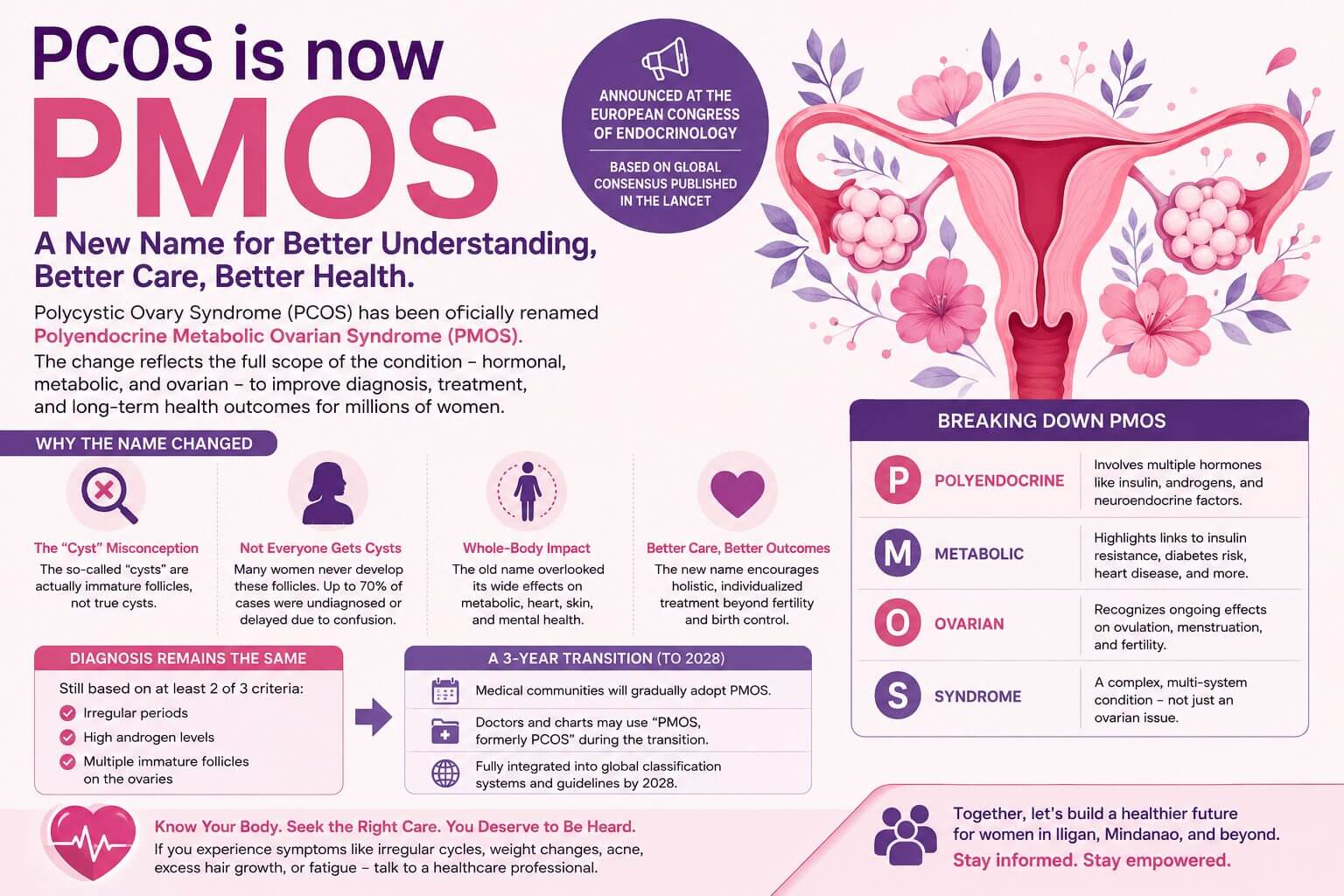
Polycystic Ovary Syndrome (PCOS), a condition affecting more than 170 million women globally, has officially been renamed Polyendocrine Metabolic Ovarian Syndrome (PMOS) following a global medical consensus announced at the European Congress of Endocrinology and published in The Lancet. The updated terminology reflects the condition’s broader hormonal and metabolic impact rather than focusing narrowly on ovarian “cysts,” which experts say has contributed to misunderstanding, delayed diagnosis, and incomplete care for decades. The new name emphasizes the disorder’s endocrine, metabolic, and reproductive dimensions while supporting a more holistic approach to long-term patient treatment and awareness.
PCOS Officially Renamed to PMOS
The medical community has officially introduced a landmark change in women’s health terminology by renaming Polycystic Ovary Syndrome (PCOS) to Polyendocrine Metabolic Ovarian Syndrome (PMOS). The move follows years of international collaboration among healthcare experts, researchers, and patient advocacy organizations seeking a more medically accurate and inclusive name for the condition.
Mindanao and Global Women’s Health Awareness
The renaming highlights a growing global effort to improve awareness of women’s endocrine and metabolic health conditions. Experts say the former term “PCOS” often caused confusion because many patients diagnosed with the disorder do not actually develop ovarian cysts. Instead, the condition involves a wide range of hormonal and metabolic dysfunctions that affect overall health.
Why the Old Name Was Considered Misleading
Medical researchers identified several problems with the previous terminology:
- The “cysts” associated with PCOS are usually immature follicles, not true ovarian cysts.
- Many women with the condition never develop visible ovarian follicles.
- The name focused too heavily on reproductive symptoms while overlooking metabolic and endocrine complications.
- Delayed diagnosis became common because many patients did not match the stereotypical “cyst” presentation.
According to global estimates, up to 70% of affected individuals remain undiagnosed worldwide.
Understanding the Meaning of PMOS
The new term PMOS was selected to better represent the condition’s full biological complexity.
Polyendocrine
This recognizes the involvement of multiple hormonal systems, including insulin regulation, androgen production, and neuroendocrine signaling.
Metabolic
The updated name directly acknowledges the condition’s association with:
- Insulin resistance
- Obesity and weight management difficulties
- Type 2 diabetes risk
- Cardiovascular complications
- Chronic inflammation
Ovarian
The term still maintains recognition of reproductive impacts such as:
- Irregular ovulation
- Fertility challenges
- Menstrual irregularities
- Hormonal imbalance
What This Means for Patients
Although the name has changed, the core diagnostic criteria remain largely the same. Healthcare providers still typically diagnose the condition based on at least two of the following:
- Irregular menstrual cycles
- Elevated androgen levels
- Multiple immature ovarian follicles visible on imaging
Experts emphasize that the updated terminology is intended to improve patient understanding and encourage more comprehensive treatment plans that go beyond fertility-focused care.
Transition Toward PMOS by 2028
Healthcare systems and medical organizations worldwide are expected to gradually adopt the PMOS terminology over the next three years. During this transition phase, many doctors may reference the condition as “PMOS, formerly PCOS” in medical records and patient consultations.
The name is expected to be formally integrated into international disease classification systems and updated global clinical guidelines by 2028.
Conclusion
The transition from PCOS to PMOS represents more than a simple name change. It reflects decades of scientific progress in understanding a condition that affects millions of women worldwide. By recognizing the disorder as a complex endocrine and metabolic syndrome rather than a purely ovarian issue, healthcare providers hope to improve awareness, diagnosis, treatment quality, and long-term patient outcomes.
FAQ for PCOS Renamed to PMOS
1. What does PMOS stand for?
PMOS stands for Polyendocrine Metabolic Ovarian Syndrome, the new official name for PCOS.
2. Why was PCOS renamed?
Experts determined that the old name inaccurately focused on ovarian cysts and failed to reflect the condition’s broader hormonal and metabolic effects.
3. Does the name change affect diagnosis?
No. The main clinical diagnostic criteria remain unchanged.
4. Is PMOS a reproductive disorder only?
No. PMOS is now recognized as a multisystem endocrine and metabolic condition affecting overall health.
5. When will PMOS fully replace PCOS?
Medical organizations are expected to fully adopt the PMOS terminology globally by 2028.
Explore Mindanao’s Growing Health Awareness
As global healthcare continues evolving, better understanding of women’s hormonal and metabolic conditions can lead to earlier diagnosis, improved treatment access, and stronger public awareness across communities in Iligan and Mindanao. Staying informed empowers individuals to seek comprehensive care and support long-term wellness.




Recent Hot Topics
Iligan’s Trexy Paris Roxas Crowned Miss Eco Teen International Philippines 2026
Mindanao River Basin Council Adopts Unified Master Plan for Flood Control and Climate Resilience
Iligan’s Meku Coffee and Le Haru Cafe Receive Halal Certification