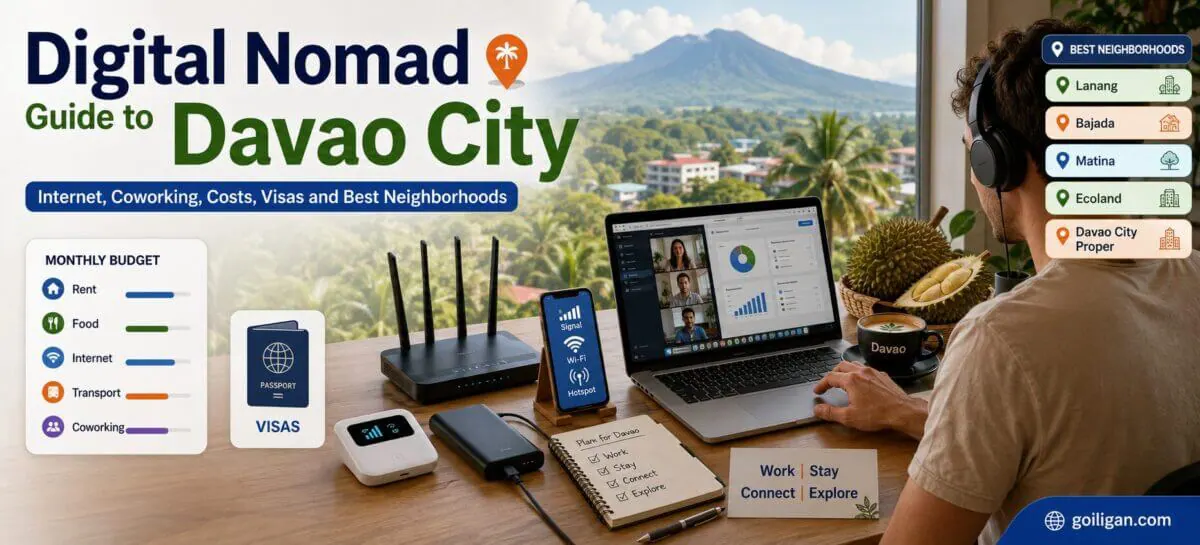
Davao City can be a practical base for digital nomads who want lower living costs, a large urban service network, access to beaches and mountains, and fewer big-city pressures than Metro Manila. Remote workers can find fiber internet, furnished monthly rentals, coworking facilities, cafés, shopping centers, private hospitals, delivery apps, and direct access through Davao International Airport.
Explore this topic: Mindanao Guides Hub
The city works best for nomads who are comfortable arranging their own backup internet, checking rental inclusions carefully, and building a social network outside the concentrated nomad scenes found in places such as Chiang Mai, Bali, or Siargao.
Quick verdict: Choose Davao when you want an urban base in Mindanao with practical amenities, relatively affordable housing, and access to nature. Do not choose it solely because someone promises uninterrupted internet, an established digital-nomad community, or a special remote-work visa.
This guide follows the uploaded content brief’s emphasis on practical costs, connectivity, neighborhoods, visa considerations, and an honest assessment of Davao’s limitations.
Davao City at a Glance for Remote Workers
| Factor | What digital nomads should expect |
|---|---|
| Best for | Long-stay remote workers, freelancers, online business owners and couples |
| Main urban areas | Poblacion, Bajada, Lanang, Matina, Ecoland and Maa |
| Internet options | PLDT Home Fibr, Globe At Home, Converge and mobile data |
| Mobile networks | Smart, Globe and DITO |
| Typical monthly rent | Around ₱10,000 to ₱30,000 for many rooms, studios and one-bedroom units |
| Coworking availability | Smaller selection than Manila or Cebu |
| Transport | Jeepneys, taxis, Grab and private vehicle rentals |
| Local language | Cebuano is widely spoken; Filipino and English are commonly understood |
| Major advantage | Urban services combined with access to Mindanao destinations |
| Main limitation | Traffic, variable internet by building, and a dispersed remote-work community |
Published consumer cost databases place a one-bedroom apartment in central Davao at roughly ₱17,300 per month and one outside the center at approximately ₱10,760. These figures are reference points rather than guaranteed rental prices. Furnished condos, short-term leases and units near business districts can cost considerably more.
Why Davao City Is Emerging as a Remote-Work Base
Davao City is a highly urbanized city and the administrative and commercial center of the Davao Region. The city government describes it as a gateway to Mindanao and an entry point for the Brunei Darussalam–Indonesia–Malaysia–Philippines East ASEAN Growth Area. It is also home to communities representing Davao’s 11 ethnolinguistic tribes.
For a remote worker, its importance is practical. Davao has:
- A major airport within the urban area
- Fiber internet from several national providers
- Large shopping centers and supermarkets
- Private hospitals and diagnostic facilities
- Food, grocery and courier delivery services
- Condominiums and furnished rentals
- Cafés and flexible workspaces
- Access to Samal Island, Mount Apo and other regional destinations
Davao is not a miniature Manila. Its commercial areas are spread across a large geographic area, and crossing the city during busy periods can take time. Choosing the right neighborhood matters more than living near a theoretical city center.
The local rhythm also differs from established nomad hubs. You will encounter remote employees, Filipino freelancers, outsourcing professionals, startup teams and foreign residents, but there is no single neighborhood where digital nomads dominate daily life.
That can be an advantage. Davao offers a more locally grounded experience and less of the temporary “laptop tourist” atmosphere found in heavily marketed nomad destinations.
Weather and seasonal considerations
Davao has warm, humid weather throughout the year. The southeastern part of Mindanao is less exposed to the direct path of many tropical cyclones than eastern and northern areas of the Philippines, but describing Davao as completely typhoon-free would be inaccurate.
Heavy rain, localized flooding, thunderstorms and regional weather disturbances can still affect travel, power and connectivity. A remote worker should treat weather resilience as part of the setup:
- Keep a charged power bank.
- Save critical files locally.
- Maintain mobile data on a second network.
- Avoid scheduling airport transfers with narrow time allowances.
- Check flood exposure before signing a long lease.
Internet Connectivity in Davao City
Davao City has fixed broadband services from providers that include PLDT, Globe and Converge. Mobile services are available through Smart, Globe and DITO. Provider availability depends on the street, subdivision, condominium and building management.
The logo on the router does not tell you whether a particular apartment is suitable for remote work. The building’s internal wiring, number of connected users, router placement, plan, maintenance history and local network congestion all affect actual performance.
What internet speed do remote workers need?
| Remote-work activity | Practical target |
|---|---|
| Email, messaging and web applications | 10 Mbps or higher |
| HD video meetings | 20 Mbps or higher |
| Two simultaneous video calls | 40 Mbps or higher |
| Large cloud uploads | Check upload speed, not only download speed |
| Video editing and media production | 100 Mbps or higher is preferable |
| Multiple remote workers in one unit | 100 to 300 Mbps, depending on workload |
These are planning targets, not claims about speeds available in every Davao property.
A 200 Mbps plan is useful only when the connection remains stable and its upload capacity supports your work. Latency, packet loss and brief dropouts can disrupt client calls even when a speed test shows a high download result.
Questions to ask before renting
Do not accept “fast Wi-Fi” as proof. Ask the landlord or host for:
- The internet provider and plan
- A current speed test inside the unit
- Download, upload and latency results
- Whether the connection is dedicated to the unit
- Whether the router is inside the apartment
- The most recent outage experienced
- Mobile signal strength inside the bedroom and work area
- Whether the building permits installation of another provider
For Airbnb and serviced-apartment bookings, request a screenshot recorded during local evening hours. That is when household network demand can expose congestion.
Fiber internet versus mobile data
A sensible Davao setup uses fiber as the primary connection and mobile data as backup.
Consider placing your main internet and backup SIM on different provider networks. A PLDT fiber connection paired with Smart mobile data does not always provide full network diversity because PLDT and Smart belong to the same corporate group. A Globe or DITO backup can provide another route when one network encounters a localized problem.
Pocket Wi-Fi, phone hotspot or 5G router?
A phone hotspot is enough for occasional emergencies. A pocket Wi-Fi device works for travel and short interruptions. A dedicated LTE or 5G router is better for regular backup use because it can provide:
- Better antenna positioning
- Longer operating periods
- Connections for several devices
- Ethernet ports on selected models
- Easier placement near a window
Test mobile service inside the exact unit before committing. Thick concrete walls, tinted windows and a low-floor location can reduce signal quality.
Power interruptions
Internet service can stop even when the provider’s network remains active because your router and optical network terminal need electricity.
A simple backup system includes:
- A mini uninterruptible power supply for the router
- A power bank capable of charging a laptop
- A mobile hotspot
- A nearby workspace with backup power
- Local copies of presentation files and meeting documents
Good to Know: A café with electricity is not automatically a dependable fallback. Its internet may be congested, music may be loud, and seating may be limited. Identify two backup locations before you need them.
Coworking Spaces and Cafés in Davao City
Davao has flexible offices and shared workspaces, but the market changes frequently. Some facilities focus on private offices, virtual offices and team rentals instead of individual day passes.
Third-party workspace platforms currently advertise Davao coworking access, with published indicative prices starting around ₱1,090 for a day workstation and approximately ₱6,290 for a monthly dedicated workstation. These are platform figures, can exclude charges, and should not be treated as universal local prices.
How to evaluate a Davao coworking space
Before paying for a pass, ask about:
| Feature | What to confirm |
|---|---|
| Internet | Provider, backup line and upload performance |
| Electricity | Generator coverage and supported outlets |
| Calls | Phone booths or rooms for private meetings |
| Day access | Exact hours and re-entry rules |
| Monthly plan | Assigned seat or hot desk |
| Meeting rooms | Member rate, capacity and booking process |
| Noise | Dedicated quiet zone or open collaborative space |
| Security | Locker availability and after-hours access |
| Food | Outside-food policy and nearby meal options |
| Parking | Availability, rates and motorcycle access |
A monthly membership is not automatically cheaper. A nomad who works from home four days a week can spend less by buying several day passes and reserving meeting rooms only when required.
Cafés as workspaces
Davao has branches of national coffee chains and many independent cafés across Lanang, Bajada, Poblacion, Matina and Ecoland.
Cafés work for:
- Email and administrative tasks
- Writing
- Research
- Short meetings
- One or two hours between appointments
They are weaker choices for:
- Confidential client calls
- Long video conferences
- Large uploads
- Work requiring an external monitor
- A full eight-hour shift
- Tasks involving sensitive customer information
Before ordering and opening your laptop, check:
- Outlet availability
- Mobile signal at your seat
- Wi-Fi access policy
- Music and conversation levels
- Table size
- Air-conditioning
- Closing time
- Whether laptop use is appropriate during peak meal periods
The quietest period is commonly after the morning rush and before the late-afternoon crowd, but activity differs by branch and day.
A better weekly work pattern
A practical arrangement is:
- Home: Deep work, writing and routine calls
- Coworking space: Client meetings and high-stakes presentations
- Café: Light work and short sessions
- Mobile backup: Urgent work during an outage
This gives you redundancy without paying for a premium desk every day.
Cost of Living for Digital Nomads in Davao City
Davao remains less expensive than many major international nomad centers, but it is no longer uniformly cheap. New condominiums, imported food, frequent Grab trips and daily café spending can push a monthly budget upward quickly.
Public cost data in 2026 lists an average central one-bedroom apartment of approximately ₱17,300 and an apartment outside the center at about ₱10,760. Another current cost database places a furnished 45-square-meter studio in a normal area near ₱13,970 and an equivalent unit in a higher-priced area near ₱26,626.
Use these as orientation figures. Rental listing prices are asking prices, and the final cost depends on furnishing, lease length, parking, building fees and utilities.
Sample monthly budget
| Expense | Budget setup | Mid-range setup | Comfortable setup |
|---|---|---|---|
| Rent | ₱8,000–₱14,000 | ₱15,000–₱25,000 | ₱28,000–₱45,000 |
| Electricity and water | ₱2,500–₱4,500 | ₱4,000–₱7,000 | ₱6,000–₱10,000 |
| Home internet | ₱1,500–₱2,500 | ₱2,000–₱3,000 | ₱2,500–₱4,000 |
| Mobile data | ₱500–₱1,000 | ₱800–₱1,500 | ₱1,500–₱2,500 |
| Food | ₱9,000–₱14,000 | ₱15,000–₱24,000 | ₱25,000–₱40,000 |
| Transportation | ₱2,000–₱4,000 | ₱4,000–₱8,000 | ₱8,000–₱15,000 |
| Coworking and cafés | ₱1,000–₱3,000 | ₱4,000–₱8,000 | ₱8,000–₱15,000 |
| Leisure and fitness | ₱2,000–₱5,000 | ₱5,000–₱10,000 | ₱10,000–₱20,000 |
| Planning total | ₱26,500–₱48,000 | ₱49,800–₱86,500 | ₱89,000–₱151,500 |
These are planning ranges, not official cost averages. Air-conditioning use, accommodation type, imported products, nightlife and intercity travel can alter the total substantially.
Budget digital nomad
A budget setup is possible when you:
- Rent a room, older studio or unit outside premium condominium districts.
- Cook most meals.
- Use jeepneys for routine trips.
- Work primarily from home.
- Use cafés selectively.
- Avoid short-term rental premiums.
A realistic target is around ₱30,000 to ₱45,000 per month, excluding international insurance, visa expenses and flights.
Mid-range digital nomad
A mid-range setup can include:
- A furnished studio or one-bedroom apartment
- Fiber internet
- Regular air-conditioning
- A combination of cooking and dining out
- Several Grab trips each week
- Coworking passes or café sessions
- Weekend activities
Plan for approximately ₱50,000 to ₱85,000 per month.
Comfortable long-stay setup
A higher budget can cover:
- A newer condominium in Lanang, Bajada or Ecoland
- Building amenities
- Frequent restaurant meals
- Regular coworking access
- Gym membership
- Private transportation
- Domestic travel
A comfortable lifestyle can exceed ₱90,000 per month, especially for couples choosing newer furnished units.
Electricity deserves special attention
Air-conditioning can become one of the largest variable expenses. Ask the landlord:
- Whether the air-conditioner is inverter type
- Its horsepower and age
- Whether electricity is billed at the utility rate
- Whether the building adds an administrative charge
- Whether common-area electricity is included in association dues
A low advertised rent can become a poor deal when utilities are billed through a marked-up submeter.
Best Davao Neighborhoods for Remote Workers
There is no single best neighborhood for every digital nomad. Select an area based on your work routine, airport needs, transport habits and preferred type of accommodation.
Lanang
Lanang suits nomads who want access to the airport side of the city, malls, hotels, restaurants and newer condominium developments.
Advantages
- Closer to Davao International Airport than southern districts
- Access to SM Lanang Premier and nearby commercial areas
- Newer condominium and serviced-apartment options
- Practical for business travelers
- Easier access toward Sasa and the Samal ferry areas
Limitations
- Rental prices can be higher near premium developments.
- Traffic builds along major roads.
- Some residential areas are less walkable than they appear on a map.
- Taxi or Grab spending can accumulate.
Best for: Frequent flyers, business travelers and nomads who prefer newer urban developments.
Bajada and J.P. Laurel Avenue
Bajada sits between the city center and Lanang. It gives residents access to Abreeza, hospitals, offices, restaurants and several transport routes.
Advantages
- Central position between downtown and the airport side
- Broad range of food and retail options
- Condominiums and apartment buildings
- Access to major roads and public transport
Limitations
- Road noise in units facing main corridors
- Congestion during peak periods
- Higher rents near major commercial properties
- Uneven pedestrian conditions
Best for: Remote workers who want central access without living in the downtown core.
Poblacion and the City Proper
Poblacion places residents close to government offices, universities, older commercial districts, Roxas Avenue and many jeepney routes.
Advantages
- Central location
- Public transport access
- Local restaurants, markets and services
- Walkable pockets around selected downtown blocks
- Easier access to civic and administrative offices
Limitations
- Older buildings can have weaker wiring or limited parking.
- Street noise varies by block.
- Furnished long-stay inventory can be less polished.
- Flood exposure should be checked for the exact street.
Best for: Nomads who prefer a busy local environment and rely on public transport.
Matina
Matina offers subdivisions, apartments, malls, schools and access to the southern side of Davao.
Advantages
- Wide range of rental types
- Residential options away from main-road noise
- Access to NCCC-area commercial activity and nearby establishments
- Jeepney connections toward downtown and southern districts
- Suitable for longer stays
Limitations
- Conditions vary greatly between subdivisions and roadside properties.
- Traffic can slow trips toward northern Davao.
- Some units require tricycle or motorcycle connections to main roads.
- Mobile and fiber availability must be checked property by property.
Best for: Longer-stay nomads seeking residential choices and a balance between price and city access.
Ecoland
Ecoland is known for SM City Davao, condominium developments, transport access and proximity to the Davao City Overland Transport Terminal area.
Advantages
- Access to a major mall and supermarket
- Condominiums and furnished rentals
- Useful for travelers taking buses to other Mindanao destinations
- Restaurants and services within the district
Limitations
- Travel to the airport and Lanang can take time.
- Congestion increases during shopping and commuting periods.
- Some listings use “Ecoland” broadly, so verify the exact address.
- Building-specific internet and noise conditions vary.
Best for: Nomads who want mall access and plan to explore southern Mindanao by bus.
Maa
Maa has residential developments, subdivisions and connections toward central and western parts of Davao.
Advantages
- Quieter residential pockets
- Houses, rooms and apartment-style rentals
- Access to several city routes
- Suitable for residents who prefer a neighborhood setting
Limitations
- A vehicle or frequent taxi use can be helpful.
- Walkability varies.
- Listings can be far from main transport routes.
- Internet availability requires exact-address confirmation.
Best for: Long-term remote workers who value residential space more than immediate nightlife or mall access.
How to Find Monthly Accommodation
Monthly rentals can be found through:
- Airbnb monthly stays
- Local property portals
- Facebook housing groups
- Condominium leasing offices
- Licensed real estate brokers
- Local property managers
- Referrals from employers or coworking communities
Airbnb advertises monthly rentals in Davao with kitchens and Wi-Fi, but a platform listing still requires verification of actual work conditions, utility limits and building rules.
Check these before paying
Request the following:
- Full property address
- Live video walkthrough
- Current internet speed test
- Written list of included utilities
- Electricity billing method
- Water charges
- Association dues
- Security deposit terms
- Refund and early-termination rules
- Inventory of furniture and appliances
- Visitor and delivery rules
- Building generator coverage
- Flood history of the immediate area
- Signed lease or booking agreement
- Proof that the person offering the unit can lease it
Common rental terms
Long-term rentals frequently request:
- One month’s advance rent
- One or two months’ security deposit
- A minimum lease period
- Identification documents
- Postdated checks for selected properties
These terms are not universal. Do not transfer a deposit solely because a social-media post creates urgency.
Short stay first, long lease later
Book a temporary unit for your first one or two weeks. Use that time to:
- Test the commute
- Compare mobile networks
- Visit apartments personally
- Assess street noise at night
- Check drainage after rain
- Test food delivery coverage
- Confirm access to groceries and laundry services
A map pin cannot reveal whether the neighboring property has construction work, karaoke sessions or early-morning traffic.
Transportation and Getting Around Davao
Davao’s size shapes daily life. A property that looks central can still be inconvenient when your appointments are on the opposite side of the city.
Jeepneys
Jeepneys are the lowest-cost option for common urban routes. They are useful when:
- Your home is near a main road.
- Your destination is on a direct route.
- You travel outside peak periods.
- You carry minimal equipment.
Route signs can be difficult for newcomers. Ask the driver or another passenger whether the vehicle passes your destination before boarding.
Taxis
Metered taxis are widely used for airport transfers, meetings and trips with luggage. Carry small bills and confirm that the meter is running.
Grab
Grab provides app-based transport in Davao, subject to vehicle availability and demand. It offers easier destination entry and digital trip records, but fares rise during busy periods and bad weather.
Motorcycle transport and rentals
Motorcycle-based travel can reduce journey time, but road safety, weather, licensing, insurance and helmet quality require careful consideration. Do not rent or operate a vehicle without confirming that your licence is valid for use in the Philippines and that the rental includes appropriate documentation.
Walking
Davao has walkable sections, not a continuous walkable city environment. Pavement quality, shade, crossings and roadside conditions differ sharply by district.
Choose accommodation within walking distance of one or two daily essentials, such as:
- A supermarket
- A pharmacy
- A café
- A laundry service
- A gym
- A public transport route
That small decision can remove dozens of unnecessary rides each month.
Visa Requirements and Legal Considerations
Foreign nationals must follow Philippine immigration rules based on nationality, admission status and intended activities.
The Bureau of Immigration states that qualified non-visa-required tourists can be admitted for an initial 30-day stay and can apply for a 29-day visa waiver. Tourist visa extensions are also available through the Bureau’s eServices system.
The Bureau advises temporary visitors to file an extension before their authorized stay expires and states in its public FAQ that applications can be submitted seven days before expiration.
Do digital nomads need a special Davao visa?
Davao City does not issue its own visa. Immigration permission is handled nationally by the Philippine Bureau of Immigration.
Do not assume that a tourist admission automatically authorizes:
- Employment by a Philippine company
- Providing services to Philippine clients
- Operating a local business
- Receiving local compensation
- Conducting activities requiring a work permit
Remote work for an overseas employer and local employment are not interchangeable legal situations. Immigration, employment and tax obligations depend on the person’s activities, length of stay, source of income and residency position.
For extended stays or any local commercial activity, consult:
- The Bureau of Immigration
- The Bureau of Internal Revenue
- A Philippine immigration lawyer
- A qualified Philippine tax professional
Visa extensions
The Bureau of Immigration’s online system offers visa-extension services, reducing the need for some in-person transactions. Requirements, fees and eligibility can change, so use the official eServices portal rather than relying on old blog posts or social-media comments.
Keep digital and printed copies of:
- Passport identification page
- Entry stamp or electronic travel record
- Current visa or stay authorization
- Extension receipts
- Accommodation address
- Return or onward travel information
- Travel insurance
- Emergency contacts
Taxes
Tax residency is not determined by what a traveler calls themselves. A long stay, local business activity or Philippine-sourced income can create obligations requiring professional review.
Do not base tax decisions on statements such as “foreign clients mean no local tax.” The actual analysis can depend on residency, treaty provisions, source rules and business structure.
Health and travel insurance
Choose insurance that clearly covers:
- Outpatient treatment
- Hospital admission
- Emergency evacuation
- Motorcycle-related incidents, when relevant
- Pre-existing conditions, when applicable
- Trips around Mindanao
- The full duration of your stay
Confirm whether payment is direct to the hospital or reimbursement after treatment.
Banking, Payments and Managing Money
Cash remains useful for jeepneys, small stores, local markets and establishments with connectivity problems.
Digital nomads commonly combine:
- An international debit or credit card
- A multi-currency transfer service
- Cash withdrawals
- A locally available e-wallet when eligible
- A backup card stored separately
Before using an ATM, review:
- The local ATM charge
- Your bank’s foreign transaction fee
- Currency-conversion terms
- Daily withdrawal limits
Select Philippine pesos when a terminal offers to convert the charge into your home currency unless you have confirmed that the offered conversion is better. Merchant or ATM conversion can include an unfavorable exchange rate.
Do not depend on one card. A fraud alert, damaged card or overseas verification problem can freeze access at the worst possible moment.
Community, Networking and Social Life
Davao’s remote-worker community is distributed across business groups, technology events, language exchanges, sports communities, churches, volunteer groups and social-media networks.
Search for current communities using terms such as:
- Davao digital nomads
- Davao expats
- Davao freelancers
- Davao remote workers
- Davao startups
- Davao technology events
- Davao hiking groups
- Davao language exchange
- Davao business networking
Review group activity before joining. A large membership number means little when the last genuine discussion happened two years ago.
How to build a local network
A practical first-month approach:
- Attend one coworking or startup event.
- Join one fitness or outdoor group.
- Attend a professional meetup related to your field.
- Work regularly from the same café or workspace.
- Join a local-interest community rather than only an expat group.
- Learn basic Cebuano phrases.
Useful everyday phrases include:
| Cebuano | English |
|---|---|
| Maayong buntag | Good morning |
| Salamat | Thank you |
| Palihog | Please |
| Tagpila ni? | How much is this? |
| Asa dapit? | Where is it? |
| Para | Please stop here |
| Wala ko kasabot | I do not understand |
| Pwede English? | Can we use English? |
English is widely used in business and service settings, but a few Cebuano phrases help with everyday interactions.
Work-Life Balance in and Around Davao
Davao works as a base for travelers who want city services during the week and outdoor trips during free days.
Possible activities include:
- Visiting museums and cultural sites
- Exploring local food and fruit markets
- Spending a day on Samal Island
- Joining an organized Mount Apo trip
- Visiting the Philippine Eagle Center
- Exploring upland areas around Calinan and Toril
- Traveling to destinations across Davao Region
- Using Davao as a transport hub for other parts of Mindanao
Mount Apo trips require proper planning, local coordination and compliance with current access rules. It should not be treated as a casual half-day hike.
Samal Island is nearby geographically, but port queues, ferry procedures and road traffic affect total travel time. Do not schedule an important client call immediately after a return crossing.
Safety for Digital Nomads and Solo Travelers
Davao has extensive urban communities and commercial districts, but no city should be treated as risk-free.
Basic precautions include:
- Use registered transport services.
- Keep bags closed in crowded areas.
- Avoid displaying expensive devices near open roads.
- Do not leave laptops unattended in cafés.
- Verify rental agents and property owners.
- Avoid isolated routes late at night.
- Store passport copies separately.
- Share trip plans for out-of-city travel.
- Follow current local and national travel advisories.
- Check regional conditions before traveling beyond Davao City.
Security conditions can differ between Davao City and other parts of Mindanao. A general statement about one location should not be applied to the entire island.
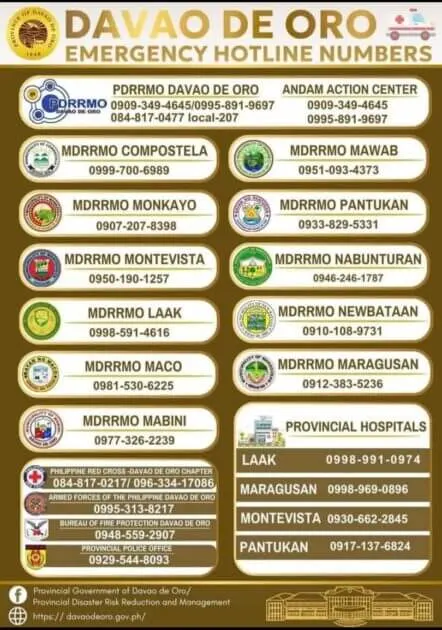
For emergencies, the Philippines uses 911 as the national emergency number. Confirm local hospital, building-security and accommodation contacts after arrival.
Practical Plan for Your First Month
Week 1: Establish the basics
- Check into temporary accommodation.
- Buy or activate two mobile-network options.
- Test internet from your bedroom and desk.
- Locate a supermarket, pharmacy, ATM and laundry service.
- Identify one coworking space and one café backup.
- Save emergency and accommodation contacts.
Week 2: Compare neighborhoods
Visit prospective long-term areas during:
- Morning commuting time
- Midday
- Evening rush hour
- Night
- Rainy conditions, when possible
Inspect actual units instead of choosing solely from listing photos.
Week 3: Build your work system
Set up:
- Primary fiber connection
- Mobile internet backup
- Router power backup
- Cloud and local file storage
- A quiet call location
- A written outage plan
Test your fallback setup before an important meeting.
Week 4: Create a sustainable routine
Decide which days are for:
- Deep work
- Coworking
- Meetings
- Errands
- Exercise
- Local exploration
- Regional trips
A good nomad base is not the one with the cheapest rent. It is the one that lets you work consistently without turning every ordinary task into a transport puzzle.
Honest Limitations of Davao for Digital Nomads
Davao has real strengths, but it is not the right base for everyone.
The remote-worker community is dispersed
You will find freelancers, foreign residents and online workers, but the community is not concentrated in one district. Building connections requires effort.
Traffic affects location choices
Living far from your preferred workspace, gym or social circle can create unnecessary daily travel.
Internet quality is building-specific
Fiber availability in a neighborhood does not prove that a particular unit has a strong connection.
Walkability is inconsistent
Some areas support short daily walks. Others make a vehicle or frequent ride-hailing necessary.
Coworking choices are limited compared with Manila and Cebu
Workspace availability can change, and several providers prioritize corporate offices over individual nomad passes.
Humidity and heat affect comfort and electricity costs
A low-rent unit without airflow can require frequent air-conditioning, raising the real monthly cost.
Regional travel requires planning
Davao is a useful Mindanao gateway, but distances are significant and transport schedules, road conditions and regional advisories must be checked.
Is Davao City a Good Digital Nomad Destination?
Davao City is a good option for remote workers who want an affordable urban base, modern daily services and access to Mindanao’s landscapes and communities. It fits long-stay nomads who value stability, local life and practical infrastructure over a concentrated international nomad scene.
Choose Davao when you:
- Work independently
- Can maintain backup internet
- Want lower housing costs than many capital-city districts
- Prefer a large regional city
- Plan to explore Mindanao
- Are willing to build your own community
Consider another destination when you need:
- A dense coworking ecosystem
- Extensive walkability
- A large international nomad district
- Guaranteed late-night transport
- A beach directly outside your accommodation
- Constantly changing social events designed for travelers
Davao’s value is not that it imitates Bali, Cebu or Manila. Its appeal is that it remains a functioning Mindanao city where remote work can fit into ordinary local life.
Frequently Asked Questions
Is Davao City safe for digital nomads and solo travelers?
Davao can be navigated safely with normal urban precautions, but personal safety depends on the neighborhood, time, transportation and activity. Follow official advisories and do not apply conditions in Davao City to every location in Mindanao.
What is the average internet speed in Davao City?
There is no single dependable citywide speed for remote workers. Fiber plans can advertise high speeds, but actual performance depends on the provider, address, building wiring, plan and congestion. Request an in-unit speed test showing download, upload and latency before renting.
How much does it cost to live in Davao as a digital nomad?
A budget-conscious remote worker can plan around ₱30,000 to ₱45,000 per month. A mid-range setup can cost ₱50,000 to ₱85,000. Newer accommodation, frequent restaurant meals, private transportation and regular coworking can push spending above ₱90,000.
Do I need a special visa to work remotely from Davao?
Davao does not issue a city-specific visa. Foreign visitors must follow national Philippine immigration rules. A tourist admission should not be assumed to authorize employment or local business activity.
What are the best areas for remote workers?
Lanang suits airport access and newer developments. Bajada offers central access to commercial areas. Poblacion works for public transport and downtown services. Matina provides varied residential options. Ecoland suits mall and bus-terminal access. Maa fits longer residential stays.
Can I find affordable monthly rentals?
Yes. Rooms, apartments, condominiums and furnished units are available, but prices vary sharply. Inspect the unit, verify the landlord, test the internet and obtain written payment terms before sending a deposit.
Is there a digital nomad community in Davao?
There are remote workers, freelancers, startup professionals and expatriate communities, but they are spread throughout the city. Coworking events, business groups, sports communities and interest-based meetups are more useful than waiting for a single nomad hub.
What should I bring for a remote-work stay?
Bring a universal power adapter, power bank, backup payment card, headset, portable laptop stand, travel insurance records, local file backups and an unlocked phone that supports Philippine mobile networks.
Final Checklist Before Moving to Davao
- Book temporary accommodation first.
- Confirm your immigration status through official sources.
- Test at least two mobile networks.
- Request an actual in-unit internet speed test.
- Check electricity, water and association fees.
- Inspect the neighborhood at night and during rain.
- Confirm the lease and deposit terms in writing.
- Prepare router and laptop power backup.
- Identify two alternative work locations.
- Review insurance coverage.
- Save emergency and hospital contacts.
- Build work, exercise and social routines during the first month.