
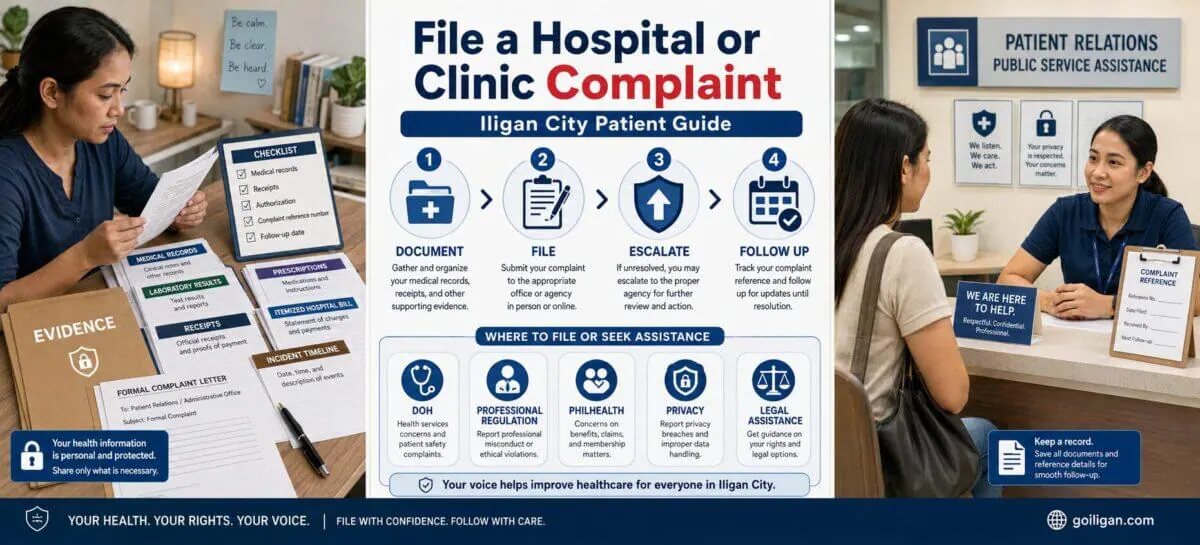
To file a complaint against a hospital or clinic in Iligan City, begin with the facility’s patient-relations, customer-service, medical director, administrator, or complaint desk. Submit the complaint in writing and keep a receiving copy. Escalate unresolved facility-level, licensing, professional-conduct, PhilHealth, or privacy concerns to the government agency with authority over that specific issue.
Explore this topic: Iligan City Services & Living Hub
The correct destination depends on what happened. A complaint about hospital operations or patient safety is different from a complaint against a licensed doctor, an incorrect PhilHealth benefit deduction, a billing disagreement, or the unauthorized disclosure of medical information.
Immediate safety note: A complaint process does not replace urgent medical care. Seek emergency treatment first when the patient remains in danger, has worsening symptoms, or needs immediate transfer.
Quick Guide: Where Should You File?
| Type of concern | Start here | Escalation option |
|---|---|---|
| Poor service, communication failure, delayed assistance, staff conduct | Hospital or clinic administrator, patient-relations office, or complaint desk | Iligan City Health Office or DOH Northern Mindanao, depending on jurisdiction |
| Unsafe facility condition, sanitation issue, licensing concern, or failure to meet facility standards | Facility administrator | Department of Health Regional Office X |
| Conduct of a licensed physician, nurse, pharmacist, medical technologist, or another regulated professional | Facility management | Professional Regulation Commission |
| PhilHealth deduction, accredited-provider conduct, benefit denial, or claims-related concern | Hospital billing or PhilHealth desk | PhilHealth Action Center or relevant PhilHealth office |
| Unauthorized disclosure, loss, or misuse of medical information | Hospital privacy officer or data-protection officer | National Privacy Commission |
| Possible negligence causing injury, disability, death, or substantial financial loss | Facility management and independent medical review | Lawyer, Public Attorney’s Office, or appropriate court |
| Complaint involving a city-run health service | Head of the facility or program | Iligan City Health Office and appropriate city office |
The Iligan City Government lists the City Health Office with telephone numbers 0917 641 1627 and (063) 221-7646, plus the email address cho@iligan.gov.ph. Confirm the correct receiving office and documentary requirements before visiting or sending sensitive records.
Understanding Your Rights as a Patient
Patients have the right to receive understandable information about their condition and proposed treatment, participate in decisions, give informed consent where required, protect the confidentiality of medical information, and raise concerns about the care they received.
Published patient-rights guidance from government hospitals states that patients can ask about the complaint process and express grievances without fear of retaliation. It also encourages patients to first speak with the healthcare provider involved and then approach the hospital’s customer-care, public-affairs, or administrative office when the concern remains unresolved.
A patient complaint can involve:
- The actual medical care provided
- The conduct of a healthcare worker
- Access to information or medical records
- Consent and communication
- Billing and benefit deductions
- Privacy and confidentiality
- Sanitation, equipment, or safety
- Discrimination or disrespectful treatment
- Failure to explain discharge instructions
- Delayed response to a patient’s documented concern
A poor outcome does not automatically prove negligence. Medicine involves risks, treatment limits, and differences in clinical judgment. A complaint is strongest when it identifies a specific act, omission, policy failure, professional violation, or measurable harm supported by records.
Grounds for Filing a Complaint Against a Healthcare Facility
Possible medical negligence
Medical negligence involves an alleged failure to exercise the level of care expected under the circumstances, resulting in injury or loss. Examples that warrant review include:
- Failure to assess a patient despite clear warning signs
- Administration of the wrong medication or dosage
- Failure to monitor a patient after a procedure
- Unreasonable delay in referring or transferring a critical patient
- Failure to communicate an important diagnostic result
- Performing a non-emergency procedure without proper consent
- Discharging a patient without necessary instructions or follow-up
- Loss or alteration of important clinical documentation
These examples do not, by themselves, establish legal malpractice. Determining negligence normally requires reviewing medical records, the patient’s condition, accepted clinical practice, causation, and the conduct of the practitioners involved.
Service delays and poor communication
Long waiting times alone do not always establish wrongdoing. A complaint becomes more specific when the delay involved:
- A patient who had already been triaged as urgent
- Repeated requests for assistance that were ignored
- Failure to explain why a procedure or discharge was delayed
- Failure to provide a referral despite the facility lacking the required service
- Loss of submitted documents that disrupted continuing treatment
Record the time of arrival, triage, consultations, requests for assistance, procedures, and discharge. A timestamped sequence is more useful than a broad statement that the hospital “took too long.”
Unprofessional conduct
Conduct complaints can include:
- Verbal abuse, humiliation, threats, or discriminatory remarks
- Refusal to explain a procedure or medication
- Improper discussion of a patient’s condition where others can hear
- Soliciting unauthorized payments
- Falsifying or improperly changing records
- Practising without a valid professional licence
- Retaliation after a patient raises a concern
A complaint against an individual licensed professional can be brought to the Professional Regulation Commission when the allegation falls within the laws, ethical standards, and regulations governing that profession.
Facility safety and sanitation
Report conditions that place patients, workers, or visitors at risk, including:
- Improper waste handling
- Unsanitary treatment areas
- Unsafe storage of medicines
- Defective equipment being used for patient care
- Failure to follow infection-control measures
- Overcrowding that creates a documented safety hazard
- Operation of a regulated service without the required authorization
Take photographs only when doing so is lawful, safe, and respectful of other patients’ privacy.
Billing and PhilHealth concerns
Billing complaints can involve:
- Charges that were not explained
- Duplicate items
- Services listed but not received
- Failure to provide an itemized statement
- Incorrect application of a PhilHealth benefit
- A request for a payment that conflicts with published benefit rules
- An accredited provider’s alleged violation of PhilHealth requirements
Ask the billing office for an itemized statement and a written explanation before escalating. PhilHealth maintains a 24-hour Action Center through (02) 8662-2588, published mobile numbers, and actioncenter@philhealth.gov.ph.
Where to File a Complaint in Iligan City
1. The Hospital or Clinic
The facility should normally receive the first formal complaint unless there is an immediate safety risk, possible evidence tampering, alleged criminal conduct, or another reason that makes internal filing inappropriate.
Ask for the office responsible for complaints. The name differs by institution:
- Patient Relations Office
- Customer Service
- Public Assistance and Complaint Desk
- Quality Management Office
- Medical Director’s Office
- Hospital Administrator
- Chief of Hospital
- Clinic owner or manager
- Data Protection Officer, for privacy concerns
Request a receiving stamp, signature, email acknowledgement, ticket number, or reference number.
A facility-level complaint gives management an opportunity to:
- Retrieve the complete chart
- Interview the staff involved
- Correct a billing error
- Explain the clinical process
- Implement corrective action
- Arrange a meeting
- Issue a written response
- Preserve relevant records
Do not surrender your only copy of any document.
2. Iligan City Health Office
The Iligan City Health Office is a useful local contact point for concerns involving city health programs, city-operated services, public-health issues, and guidance on the appropriate government authority.
The city government publishes the following contact information:
- Telephone: 0917 641 1627
- Landline: (063) 221-7646
- Email: cho@iligan.gov.ph
- Official page: LGU Iligan City Health Office
- City directory: Iligan City Government contact directory
The City Health Office does not automatically replace DOH, PRC, PhilHealth, the National Privacy Commission, or a court. Its role depends on the facility, service, and nature of the allegation. Contact the office first and ask whether it has direct jurisdiction or will refer the complaint.
3. Department of Health Regional Office X
The Department of Health Regional Office X is the regional DOH office serving Northern Mindanao.
DOH is the appropriate escalation channel for concerns involving matters within its regulatory authority, including licensed health facilities, facility compliance, health-service standards, and regulated healthcare operations.
Before submitting:
- Identify the complete official name and address of the facility.
- State whether you already complained to management.
- Attach the facility’s response or explain that no response was received.
- Ask the regional office for the current complaint form, receiving email, mailing address, or filing procedure.
- Confirm whether notarization is required.
- Remove records unrelated to the allegation.
Do not send a patient’s complete medical chart through an unverified social-media account.
4. Professional Regulation Commission
File with the Professional Regulation Commission when the complaint concerns the professional conduct of a licensed practitioner, such as a physician, nurse, pharmacist, dentist, medical technologist, physical therapist, or another PRC-regulated professional.
PRC’s published rules state that a complaint can be filed by any person or an authorized representative. Formal complaints are normally verified or embodied in an affidavit and include a certification against forum shopping.
The PRC Citizens’ Charter identifies the Office of the Legal Service, Hearing and Investigation Division, and the legal sections of regional offices as responsible for complaints against professionals. PRC also publishes filing and appeal fees, but complainants should confirm the latest amount and payment instructions before submission.
Use the PRC legal services and downloadable forms to locate the current rules and filing requirements.
A PRC complaint focuses on the professional’s licence and conduct. It does not automatically produce financial compensation for the patient.
5. PhilHealth
Contact PhilHealth when the dispute involves:
- Application of PhilHealth benefits
- Provider accreditation
- Claims processing
- Improper benefit deductions
- Alleged violations by a PhilHealth-accredited provider
- Misrepresentation in a PhilHealth transaction
The 2026 PhilHealth implementing rules provide for written complaints against healthcare providers or members for covered violations.
Current published contact channels include:
- Hotline: (02) 8662-2588
- Email: actioncenter@philhealth.gov.ph
- Smart: 0998-857-2957 and 0968-865-4670
- Globe: 0917-127-5987 and 0917-110-9812
- Website: PhilHealth
Request a reference number and save the acknowledgement.
6. National Privacy Commission
File with the National Privacy Commission when the issue involves the misuse, unauthorized disclosure, loss, disposal, or improper processing of personal or medical information.
Examples include:
- A diagnosis disclosed to an unauthorized person
- A medical record sent to the wrong recipient
- Patient information posted online
- A chart left publicly visible
- Refusal to address a documented privacy incident
- Improper collection of unnecessary personal data
The NPC states that a person whose information has been misused or whose privacy rights have been violated has the right to complain. Its complaint mechanics require the prescribed complaint format, supporting evidence, and, depending on the filing route, a notarized complaint-assisted form or verified complaint.
Review the NPC complaint-filing instructions before submission.
7. Public Attorney’s Office or a Private Lawyer
Consult a lawyer when:
- The patient suffered serious injury, permanent disability, or death
- A legal deadline may apply
- The records appear incomplete or inconsistent
- Compensation is being sought
- The parties are considering settlement
- An administrative complaint is not enough
- The case involves possible criminal conduct
- An affidavit or verified complaint must be prepared
The Public Attorney’s Office provides legal assistance subject to its eligibility rules, merit assessment, and current service requirements. PAO records identify an Iligan district office, but the current local address and intake schedule should be confirmed directly before visiting.
Step-by-Step Process for Filing Your Complaint
Step 1: Protect the patient’s immediate health
Arrange treatment, transfer, a second opinion, or emergency care before focusing on paperwork.
Ask the treating facility for:
- Discharge instructions
- Medication list
- Referral documents
- Diagnostic results needed for continuing care
- Instructions for warning signs
- Contact information for follow-up
Step 2: Write a factual timeline
Create the timeline while details remain fresh.
Include:
| Detail | What to record |
|---|---|
| Date and time | Arrival, triage, consultation, procedure, discharge, and follow-up |
| Location | Hospital, clinic, emergency room, ward, laboratory, billing desk |
| People involved | Names, titles, or physical descriptions when names are unknown |
| What happened | Exact sequence without exaggeration |
| What was requested | Treatment, explanation, referral, record, correction, or assistance |
| Response received | What the staff member said or did |
| Result | Injury, delay, additional expense, privacy exposure, or unresolved issue |
| Evidence | Record, receipt, message, photograph, witness, or reference number |
Separate facts from conclusions. Write “The nurse returned at 4:15 p.m.” instead of “The nurse intentionally ignored us.”
Step 3: Request the relevant medical and billing records
Ask for records directly connected to the complaint, including:
- Emergency-room notes
- Physician orders
- Nursing notes
- Medication administration records
- Laboratory and imaging reports
- Operative or procedure notes
- Consent forms
- Referral documents
- Discharge summary
- Itemized statement of account
- Official receipts
- PhilHealth benefit documents
- Incident report, when releasable
- Copies of written communications
The facility can apply lawful procedures for releasing medical records, including identity verification, authorization, and reproduction charges. Ask for the request process in writing.
Step 4: Preserve your evidence
Create one evidence folder with numbered attachments.
Example:
- Attachment A: Patient identification and authorization
- Attachment B: One-page incident timeline
- Attachment C: Emergency-room record
- Attachment D: Laboratory result
- Attachment E: Itemized bill
- Attachment F: Official receipts
- Attachment G: Email to the administrator
- Attachment H: Facility response
- Attachment I: Photographs
- Attachment J: Witness affidavit
Keep the original files unchanged. Save copies in at least two secure locations.
Step 5: Identify the outcome you are requesting
A complaint should state what action you want. Examples include:
- Written explanation
- Correction of a bill
- Release or correction of a medical record
- Refund of an unsupported charge
- Internal investigation
- Staff review or disciplinary action
- Referral to the licensing authority
- Privacy-incident investigation
- Policy correction
- Formal apology
- Compensation, where legally justified
Avoid demanding an outcome that the receiving office has no authority to provide.
Step 6: Submit a written complaint to the facility
Address it to the hospital administrator, medical director, clinic owner, patient-relations office, or designated complaint officer.
Submit through an official channel:
- In person
- Registered mail
- Courier
- Official institutional email
- Official complaint portal
Your complaint should contain:
- Your name and contact details
- Your relationship to the patient
- The patient’s name, with authorization where required
- Facility name and location
- Date and location of the incident
- Names or roles of the people involved
- Chronological account
- Harm or loss experienced
- Action already taken
- Requested resolution
- List of attachments
- Signature and date
Step 7: Obtain proof of filing
Keep:
- Receiving copy
- Email acknowledgement
- Courier receipt
- Registered-mail tracking
- Complaint reference number
- Name of the receiving officer
- Date of follow-up
- Promised response date
A verbal assurance is difficult to trace later.
Step 8: Allow the facility to respond
The response period depends on the institution, complaint type, complexity, and governing procedure. Do not publish an invented deadline in your letter.
Ask the facility to state:
- Its complaint reference number
- The assigned office
- The expected response date
- Whether more documents are required
- Whether a meeting will be scheduled
Follow up in writing when the promised date passes.
Step 9: Escalate to the correct authority
Escalation should match the issue:
- Facility operations or licensing: DOH
- Licensed professional conduct: PRC
- PhilHealth benefits or provider violations: PhilHealth
- Health-information privacy: NPC
- City-operated health services: Iligan City Health Office
- Compensation or legal liability: Lawyer, PAO, or court
Attach proof that the facility received the original complaint, unless immediate external filing was necessary.
Step 10: Maintain a complaint log
Record each contact:
| Date | Office or person | Method | What was submitted | Response | Next action |
|---|
This prevents the case from dissolving into a fog of phone calls and half-remembered promises.
Documents and Evidence to Prepare
Core documents
Prepare copies of:
- Government-issued identification
- Patient authorization, when filing for another adult
- Proof of relationship or authority, when required
- Written complaint
- Incident chronology
- Medical records
- Test results
- Prescriptions
- Discharge documents
- Itemized bill
- Official receipts
- PhilHealth documents
- Communications with the facility
- Photographs or videos obtained lawfully
- Witness statements
- Proof of filing and follow-up
Evidence to avoid
Do not include:
- Edited screenshots that conceal context
- Recordings obtained unlawfully
- Unrelated medical history
- Personal information belonging to other patients
- Social-media rumours
- Unverified accusations
- Threats or insulting language
- Public posts presented as a substitute for formal filing
Preparing an affidavit
An affidavit should state facts that the person personally knows. It should identify the affiant, explain the incident chronologically, identify attachments, and be signed and notarized when required.
Do not ask a witness to sign a statement they did not write, understand, or verify.
Sample Complaint Letter
[Your Full Name]
[Postal Address]
[Telephone Number]
[Email Address]

[Date]

The Hospital Administrator / Medical Director
[Official Name of Hospital or Clinic]
[Facility Address]

Subject: Formal Complaint Concerning Patient Care on [Date]

Dear Sir or Madam:

I am filing a formal complaint concerning the care or service provided to
[patient name] at [department or location] on [date].

I am the patient / the patient’s authorized representative. A copy of the
necessary identification and authorization is attached.

The incident occurred as follows:

1. At approximately [time], [state what happened].
2. At [time], I requested [state request].
3. [Name or position of staff member] responded by [state factual response].
4. The incident resulted in [describe documented harm, delay, expense, or concern].

I previously raised the matter with [office or person] on [date]. The response
received was [brief description], or no written response has been received.

I respectfully request:

1. A formal review of the incident;
2. Preservation and review of all relevant records;
3. A written explanation of the findings;
4. [Correction, refund, record release, policy review, or another requested action];
5. The complaint reference number and expected response date.

Attached are copies of the following documents:

Attachment A – Incident timeline
Attachment B – Medical record
Attachment C – Laboratory result
Attachment D – Itemized bill and receipts
Attachment E – Previous correspondence

Please acknowledge receipt through [email or telephone number].

Sincerely,

[Signature]
[Printed Name]
Administrative Complaints Versus Legal Action
An administrative complaint asks a government agency or regulator to investigate compliance, licensing, professional conduct, accreditation, or privacy obligations.
Possible administrative outcomes include:
- Written explanation
- Corrective action
- Warning
- Compliance order
- Professional discipline
- Licence or accreditation action
- Referral to another authority
A civil case normally seeks compensation or another court remedy for injury or financial loss.
A criminal complaint concerns conduct punishable under criminal law.
A single incident can create more than one pathway. A complaint about a doctor’s professional conduct, for example, can be reviewed by the hospital and PRC, while a separate civil claim addresses compensation. These processes have different requirements, evidentiary standards, costs, and deadlines.
Speak with a lawyer promptly when substantial harm occurred. Do not wait for every administrative process to finish before asking about legal deadlines.
What to Expect After Filing
The receiving office can:
- Check whether it has jurisdiction
- Request missing documents
- Forward the complaint to the proper authority
- Ask the respondent for an explanation
- Review records
- Interview involved personnel
- Schedule mediation, clarification, or a conference
- Issue findings or a resolution
- Recommend corrective or disciplinary action
- Dismiss a complaint that lacks jurisdiction or supporting evidence
Complex complaints take longer when they involve several professionals, multiple facilities, expert review, incomplete records, or disputed medical causation.
Keep following up through the same reference number. Sending repeated versions through unrelated channels can fragment the file.
Can You File Anonymously?
A facility or agency can receive an anonymous tip, especially when it concerns public safety or a continuing regulatory violation. An anonymous complaint is harder to investigate when officials cannot verify records, contact witnesses, obtain patient authorization, or ask follow-up questions.
Formal PRC, NPC, compensation, and court processes normally require the complainant’s identity and prescribed documents.
A person concerned about retaliation should ask the receiving authority how identity and sensitive records will be protected. Do not assume that anonymity can be guaranteed.
Common Mistakes That Weaken a Complaint
Posting publicly before preserving evidence
A social-media post can spread incomplete information, expose sensitive medical data, identify other patients, and complicate a formal investigation.
Sending the same complaint to every office
The case moves faster when each issue goes to the authority responsible for it.
Accusing everyone of malpractice
Name the act or omission. Avoid legal conclusions you cannot yet prove.
Submitting original documents
Provide copies unless the receiving authority specifically requires an original.
Leaving out the requested resolution
State what you want the hospital or authority to do.
Missing follow-up dates
Maintain a calendar and complaint log.
Accepting a verbal settlement without documentation
Ask for the terms, payment, correction, or promised action in writing.
Frequently Asked Questions
Where can I file a complaint against a hospital in Iligan City?
Start with the hospital’s administrator, medical director, patient-relations office, or complaint desk. Escalate facility-regulation concerns to DOH Regional Office X and seek guidance from the Iligan City Health Office when the matter involves a city service or local public-health concern.
How do I report a doctor in the Philippines?
Complain first to the hospital or clinic when appropriate. A formal administrative complaint concerning a licensed physician’s conduct can be filed with the Professional Regulation Commission under its complaint rules.
What documents do I need?
Prepare identification, patient authorization when applicable, a chronological complaint letter, relevant medical records, test results, prescriptions, bills, receipts, communications, witness statements, and proof of your earlier complaint.
How long does a DOH investigation take?
There is no single timeline that applies to every complaint. Duration depends on jurisdiction, completeness of documents, complexity, need for expert review, and the response of the facility. Ask for a reference number and the current case-processing schedule.
Is there a fee?
A hospital’s internal complaint process and initial reporting to many public agencies do not automatically require a filing fee. Certain formal proceedings, notarization, record reproduction, legal services, or PRC processes can involve charges. Confirm the current official fee before paying.
Can I receive compensation for negligence?
Compensation normally requires a settlement or legal claim supported by proof of duty, breach, causation, and damage. An administrative complaint can discipline or regulate a provider but does not automatically award damages.
Can a family member file for the patient?
A family member can assist, but an adult patient’s written authorization can be required before medical records are disclosed or a complaint is processed. Different rules apply to minors, deceased patients, incapacitated patients, and legal representatives.
What should I do if the hospital refuses to release records?
Submit a dated written request and ask for the facility’s records-release policy, requirements, lawful fees, and written reason for refusal. Escalate the concern to the hospital administrator, privacy officer, appropriate regulator, or legal counsel when necessary.
Final Complaint Checklist
Before submitting, confirm that you have:
- Protected the patient’s immediate health
- Identified the correct hospital or clinic
- Written a dated timeline
- Requested relevant medical records
- Obtained an itemized bill
- Preserved receipts and communications
- Identified the staff members involved
- Stated the specific complaint
- Explained the documented harm
- Requested a clear resolution
- Numbered the attachments
- Kept copies of every document
- Obtained proof of filing
- Recorded the complaint reference number
- Set a follow-up date
- Escalated only to the agency with authority over the issue
A healthcare complaint works best when it is calm, specific, documented, and sent through the right channel. The goal is not to produce the loudest accusation. The goal is to create a record strong enough for the hospital, regulator, or court to understand what happened and decide what action is justified.