
Introduction: Understanding Iligan City as a Living Destination
Iligan City, often called the “City of Majestic Waterfalls,” is a thriving urban center located on the northern coast of Mindanao. With a population of over 400,000, it’s become an increasingly attractive destination for Filipinos seeking relocation and, increasingly, for foreign expats looking for an affordable Philippine lifestyle. But the question everyone asks remains the same: is it actually a good place to live?
Explore this topic: Iligan Travel & Logistics Hub
The answer isn’t simple. Iligan City offers genuine advantages—exceptional natural beauty, low cost of living, and a growing economy—but it also comes with real trade-offs that matter. This guide cuts through the romantic notions and gives you the unfiltered perspective from both long-term residents who’ve chosen to stay and newcomers still adjusting to life here. We’ll address the legitimate safety concerns that keep many people away while highlighting why thousands have made Iligan their home.
Whether you’re considering Iligan for retirement, remote work, family relocation, or simply a lifestyle change, you’ll find honest answers here that match your specific situation. This isn’t a tourism guide—it’s a practical assessment of what daily life actually looks like.
Cost of Living in Iligan City: What Your Money Gets You
Iligan’s cost of living is one of its strongest selling points. Your peso stretches significantly further here compared to Metro Manila or Cebu, but you need to understand where your money actually goes.
Housing Costs Breakdown
Rent for a decent one-bedroom apartment in a safe, middle-class neighborhood ranges from ₱8,000 to ₱15,000 monthly. Two-bedroom units in established subdivisions like Saray and Pueblo run ₱12,000 to ₱20,000. If you’re willing to live further from downtown, you’ll find options at ₱6,000 to ₱10,000. House rentals for expats or larger families are typically ₱20,000 to ₱35,000 depending on location and condition.
Property purchase prices are significantly lower than nationwide averages. Residential lots in developing areas start at ₱15,000 per square meter, while established neighborhoods range from ₱25,000 to ₱45,000 per square meter. This is roughly 40-50% cheaper than comparable properties in Davao or Cebu.
Utilities and Internet
Monthly electricity bills average ₱1,500 to ₱3,500 depending on consumption and air conditioning usage. Water bills run ₱400 to ₱800. Internet is a critical factor for remote workers—reliable high-speed connections (15-25 Mbps) cost ₱1,200 to ₱1,800 monthly from providers like Converge and Sky Fiber, though availability varies by neighborhood. This is worth confirming before moving if remote work is your plan.
Food and Dining
Groceries are remarkably affordable. A monthly food budget for one person ranges from ₱3,500 to ₱5,500 if you cook at home and shop local markets. Fresh produce at the Pala-Pala Public Market is 30-40% cheaper than Manila. Dining out is equally inexpensive—a good restaurant meal costs ₱120 to ₱250, and street food is even cheaper at ₱30 to ₱60 per item.
Transportation
Public transportation costs roughly ₱8 to ₱12 per ride on jeepneys. A motorcycle (the primary transportation for locals) costs ₱3,000 to ₱5,000 for secondhand reliable models or ₱60,000 to ₱120,000 new. Car ownership means monthly gas averaging ₱3,000 to ₱5,000 depending on usage, plus minimal registration fees compared to other regions.
Realistic Monthly Budget Comparison
A comfortable lifestyle for a single person: ₱25,000 to ₱35,000 monthly (housing ₱12,000, utilities ₱3,000, food ₱6,000, transportation ₱2,000, entertainment ₱4,000). A couple: ₱35,000 to ₱50,000. Compare this to ₱50,000 to ₱75,000 for similar lifestyle in Cebu, and you understand Iligan’s appeal. However, Iligan is notably more expensive than smaller provincial cities outside Mindanao while still cheaper than major metros.
Safety and Security: How Safe is Iligan City Really?
This is the question that stops most people from moving. Let’s be direct: Iligan City has a complicated relationship with safety, and pretending otherwise would be dishonest.
Current Context
Mindanao’s security situation has improved dramatically over the past five years. Major conflict has diminished, military presence has normalized, and the narrative of “Mindanao is dangerous” doesn’t reflect current reality. That said, Iligan isn’t crime-free. Like any Philippine city of 400,000 people, it has theft, robbery, and occasional violence. The crime rate is actually comparable to Cebu City but lower than Davao City when analyzed by standard metrics.
Neighborhood-by-Neighborhood Assessment
Safe Zones: Saray (commercial/residential), Pueblo (affluent), Agora (business district), and Lanao Heights are your safest bets. Police presence is visible, residents are vigilant, and street lighting is adequate. Crime here mirrors white-collar and petty theft patterns rather than violent crime.
Moderate Caution: Downtown core and Pala-Pala Market areas are busy, commercial, and generally safe during business hours but require street awareness after dark. Pickpocketing and bag-snatching are the primary concerns.
Higher Risk: Barangays further from the city center, particularly Iligan East and some suburban areas, have higher reported incidents. Gang-related activity exists but typically doesn’t affect outsiders who stay situationally aware.
What Residents Actually Do
Long-term expat and Filipino residents agree on practical precautions: don’t flash expensive items, avoid walking alone after 10 PM, use secured taxis or personal vehicles at night, don’t wear jewelry or high-end gadgets openly, and be aware of your surroundings. These aren’t paranoia tactics—they’re standard practices in any developing-world city including Metro Manila.
Police Presence and Response
The Philippine National Police has a visible presence, and response times are reasonable in urban areas. Emergency hotline (911) works, though English proficiency varies. Many expats report successful interactions with police for minor incidents, though corruption isn’t unheard of.
Honest Assessment
Iligan is safer than its reputation suggests but less safe than first-world standards. For cautious, situationally-aware individuals, it’s a workable city. For those seeking absolute security or who feel uncomfortable in developing-world environments, the psychological toll of constant vigilance might outweigh the cost-of-living benefits. This is a personal threshold question, not an objective one.
Job Market and Economic Opportunities in Iligan City
Iligan’s economy centers on agro-industrial, manufacturing, and emerging service sectors, creating different opportunities for locals versus remote workers versus investors.
Major Industries and Employment
The industrial estate dominates: food processing, mining operations, and agricultural exports provide most formal employment. Agio Manufacturing, aquatic products processors, and agri-business companies offer middle-wage jobs (₱18,000 to ₱35,000 monthly for skilled positions). These aren’t high-paying but align with provincial standards.
The service sector is growing. Banking, telecommunications, retail management, and hospitality roles are expanding, with salaries ranging ₱20,000 to ₱45,000 depending on experience. Call center operations are minimal compared to Davao, so digital work isn’t a major local employer.
Remote Work Feasibility
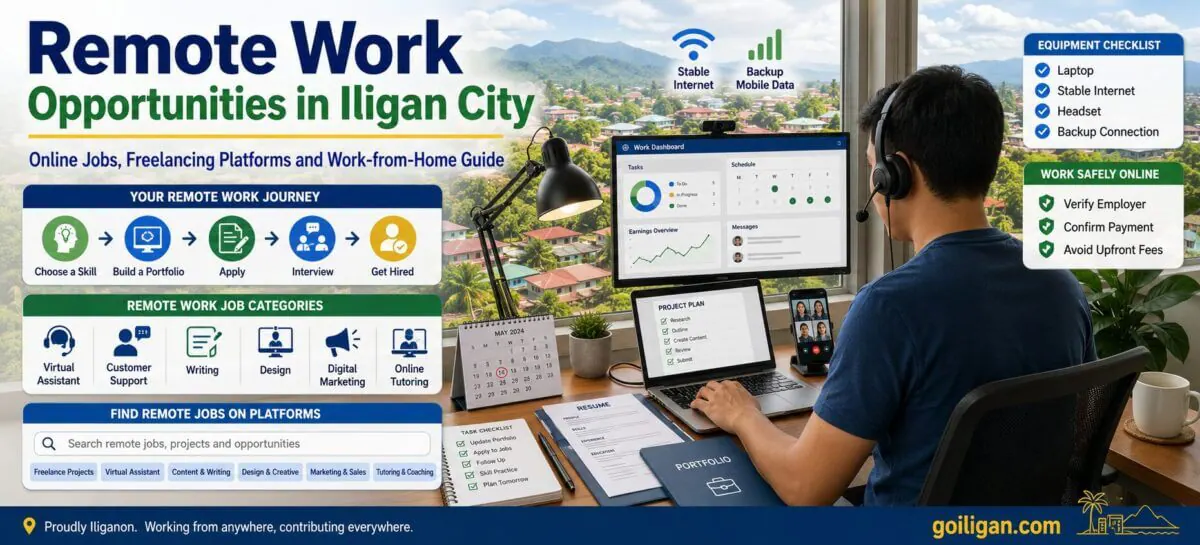
This is where Iligan becomes attractive for foreigners. Internet reliability has improved substantially since 2022. While Manila speeds (100+ Mbps) aren’t standard, 15-25 Mbps connections are now available in central neighborhoods and suffice for freelance work, digital marketing, and content creation. Backup solutions (mobile hotspot) are wise.
Expat and Foreigner Opportunities
English teaching remains viable—private schools pay ₱25,000 to ₱40,000 monthly for full-time instructors, with several international schools present. Online education platforms (English tutoring for Asian markets) offer flexible remote income. Freelancing, digital marketing agencies serving global clients, and creative work (writing, design) work if you handle your own clients.
Feasibility and Future Outlook
Iligan’s economy is growing but slowly. Job creation exists but isn’t abundant. If your income depends on local employment, Iligan works best for teaching, skilled trades, or business ownership. If you’re remote-based or bring investment, you’re in a strong position. The economic future leans positive with infrastructure investments, but don’t expect rapid growth.
Lifestyle and Daily Living: What to Expect Day-to-Day
Beyond cost and safety, living quality depends on daily expectations.
Climate and Weather
Iligan has a warm, tropical climate year-round with temperatures between 24-32°C (75-90°F). Monsoon season (June-November) brings heavy rainfall—Iligan receives among the highest rainfall in the Philippines, particularly in September-October. This means frequent afternoon thunderstorms, flooded streets during peak season, and gray skies for extended periods. If seasonal affective disorder affects you, this matters. Dry season (December-May) is genuinely beautiful.
Shopping and Retail Infrastructure
Iligan has improved significantly here. Robinsons Place (modern mall with cinema, dining, groceries) and Gaisano malls offer familiar retail. Local markets (Pala-Pala for fresh goods, downtown for everyday items) provide authentic shopping. However, selection is narrower than Manila—expect limited specialty items and higher prices for imported goods. A trip to Cagayan de Oro (90 minutes) or Davao (5 hours) becomes a twice-yearly pilgrimage for items you can’t find locally.
Food and Restaurant Scene
Surprisingly good for a city this size. You’ll find decent Filipino, Chinese, and Japanese restaurants, plus growing craft coffee shops. International cuisine is limited—authentic Western food is rare and marked up significantly. Home cooking and local restaurants are your dietary reality.
Community and Social Life
Iligan has an active expat community, particularly Koreans, Australians, and Americans. Facebook groups connect newcomers, churches offer community, and the small expat population makes friendship accessibility easy if you’re socially open. Filipinos are generally welcoming but social integration requires language effort and cultural sensitivity.
Transportation Infrastructure
Jeepney and motorcycle are primary transport. No public buses like Manila, no ride-sharing services like Grab (limited presence). Getting around requires familiarity with jeepney routes or a personal motorcycle/tricycle. This is either charming or frustrating depending on your personality.
Entertainment and Recreation
Nightlife is modest—bars and karaoke exist but aren’t extensive. Movie theaters, bowling, gym facilities, and outdoor activities (waterfalls, hiking) are accessible. For someone seeking vibrant nightlife or cultural diversity, this is limiting. For someone seeking quiet, nature-based living, it’s perfect.
Healthcare, Education, and Essential Services
Medical Facilities
Iligan City Hospital and Polymedic General Hospital provide government and private care respectively. Both are competent for standard issues—emergency care, routine surgeries, childbirth, infectious disease treatment. Specialist care is more limited; serious cases often transfer to Davao or Cagayan de Oro. Dental care is available and cheap (₱500 for cleanings, ₱2,000-3,000 for fillings). Medical costs are significantly lower than Western standards.
Pharmacies are plentiful and well-stocked. Many medications available only by prescription in Western countries are over-the-counter here. Overall healthcare accessibility is good for basic to moderate needs; complex cases require travel.
Education
Mindanao State University (MSU) is a major institution offering quality higher education. Several international schools serve expat families: Iligan City National High School, Liceo de Iligan. Quality varies; research specific schools if you have school-age children. Education costs for international schools run ₱40,000 to ₱80,000 yearly, versus ₱4,000 to ₱10,000 for public schools.
Essential Services
Government services (permits, licenses, documentation) operate on Philippine bureaucratic timelines—expect administrative processes to take 2-4 weeks for straightforward items, longer for complex matters. Banking services are standard with BDO, BPI, and Metrobank branches. Internet/telephone services are provided by multiple companies, though reliability varies by provider and location.
Natural Beauty and Recreation: The Waterfall City Advantage
This is Iligan’s true competitive advantage.
Maria Cristina Falls
Maria Cristina Falls is an iconic Iligan landmark tied to the Agus hydroelectric system. Public viewing is controlled: the Philippine tourism guide describes limited visits by advance approval with no walk-ins. Ask Iligan City Tourism about the current date, vehicle rules and fee; do not rely on old free-entry or minimal-fee claims.
Additional Natural Attractions
Tinago Falls (roughly 30–45 minutes away via Buru-un) rewards a staircase descent with a turquoise swimming basin. Dodiongan Falls and Mimbalut Falls make easy half-day trips, and the cold springs of Timoga are minutes from the city. Lake Lanao, reached via Marawi City (roughly 1–1.5 hours away), offers scenic views for a longer day out. These attractions are genuinely beautiful and inexpensive to visit.
Recreation and Activities
Hiking infrastructure exists—local guides are available for ₱500-1,000 daily. Sports facilities include volleyball, badminton, and basketball courts. Gyms are present but modest (₱1,500-2,000 monthly memberships). Cycling, swimming, and outdoor sports are viable given the climate and community.
Proximity to Other Destinations
Cagayan de Oro (90 km) is reachable for bigger-city amenities. Davao (280 km) is a day trip for major shopping or flights. Camiguin Island (popular tourist destination) is 3-4 hours away. This positioning makes Iligan good for those who want nature-based living with occasional city access.
Air Quality and Environment
Iligan’s air quality is generally good—no heavy industrial smog despite manufacturing presence. Water quality varies; tap water is technically drinkable in modern areas but many residents use filters or drink bottled water as precaution. Environmental consciousness is growing but infrastructure for waste management remains developing-world standard.
Pros and Cons: The Real Picture of Living in Iligan City
Top Advantages
- Exceptional Cost of Living – Your money genuinely goes far, especially for housing and food. This is objective and significant.
- Natural Beauty – Waterfall city status isn’t marketing—the scenery is genuinely remarkable for tropical living.
- Growing Economic Stability – Unlike declining provincial cities, Iligan is growing. Economic future is cautiously optimistic.
- Genuine Community – The expat and Filipino community is welcoming and supportive, making transition easier than many Philippine cities.
- Simpler Lifestyle – Slower pace, lower pressure, nature-proximity—if you’re escaping rat-race mentality, this delivers.
Real Drawbacks
- Limited Selection and Availability – Specialty items, Western products, healthcare specialists require travel or acceptance of limitation.
- Rainy Season Intensity – The 8-month monsoon period brings genuine flooding in some areas and constant moisture that affects mood and mold.
- Safety Perception vs. Reality Gap – Regardless of actual safety improvements, the reputation creates psychological burden and limits some activities.
- Modest Job Market – Local employment is limited; you need either remote income, teaching qualification, or entrepreneurial skill.
- Infrastructure Gaps – Public transportation is basic, road conditions are inconsistent, power outages occur (though less frequently than previously).
- Healthcare Limitations – Basic care is solid; specialized/emergency serious care requires Davao travel.
Who Iligan Is Best Suited For
- Remote workers seeking low cost of living and nature
- Retirees with fixed income (pension) prioritizing affordability
- Teachers and educators
- Nature enthusiasts over city-culture people
- Those comfortable with developing-world infrastructure
- Entrepreneurs or business owners
Who Should Probably Look Elsewhere
- Those requiring specialist healthcare access
- High-income earners accustomed to first-world amenities
- People needing guaranteed internet reliability for critical work
- Those seeking extensive nightlife and cultural activities
- Individuals uncomfortable with developing-world conditions
- Those easily frustrated by bureaucratic processes
Conclusion: Is Iligan City Right for You?
Iligan City isn’t universally right for everyone, but it’s genuinely right for specific people. The honest answer is: it depends entirely on your priorities.
If you prioritize cost, natural beauty, and simplicity over convenience and amenities, Iligan works. The ₱25,000-35,000 monthly budget reality, the waterfall views, the welcoming community, and the genuine sense of peace attract thousands for good reason.
If you need city amenities, healthcare specialists, constant internet reliability, or extensive entertainment options, Iligan requires compromises that might outweigh benefits.
The key is honest self-assessment. Visit for 2-4 weeks if possible. Spend a full monsoon season day experiencing the rain intensity. Talk to established residents about their genuine frustrations. Connect with the expat Facebook group and ask direct questions. Rent before buying. Give yourself 3-6 months to see if the lifestyle truly fits before making permanent decisions.
Iligan City isn’t a romantic escape fantasy—it’s a real city with genuine advantages and real limitations. Assess your actual needs, spend time here, and make decisions based on the real picture rather than cost-of-living dreams or expat blogs. For those whose authentic preferences align with what Iligan offers, it’s an excellent place to live. For others, it’s a mismatched experiment worth avoiding.
The question isn’t whether Iligan is good generally—it’s whether Iligan is good specifically for you.
FAQ – People Also Ask
Q1: What is the average cost of living in Iligan City? A comfortable lifestyle costs ₱25,000-35,000 monthly for a single person (housing ₱12,000, utilities ₱3,000, food ₱6,000, transportation ₱2,000, entertainment ₱4,000). Couples typically budget ₱35,000-50,000. This is 40-50% lower than Metro Manila or Cebu.
Q2: Is Iligan City safe for foreigners and expats? Iligan is safer than its reputation suggests. Standard precautions (don’t flash valuables, avoid late-night solo walks, stay aware) make it workable for cautious individuals. It’s comparable to other Philippine cities—not crime-free but manageable with reasonable awareness.
Q3: What are the job opportunities in Iligan City? Local employment is limited. Best options: English teaching (₱25,000-40,000), skilled trades, business ownership, or agricultural sector work. Remote work for international clients is increasingly viable. Most sustainable for foreigners is remote income combined with local teaching or business.
Q4: How is the internet connection in Iligan City? Internet has improved significantly. Converge and Sky Fiber offer 15-25 Mbps connections (₱1,200-1,800 monthly) in central areas. Adequate for remote work but not Manila-standard speeds. Backup mobile hotspot recommended for critical work. Availability varies by specific neighborhood.
Q5: What is the weather like in Iligan City year-round? Warm tropical year-round (24-32°C). December-May is dry, pleasant, and ideal. June-November is monsoon season with heavy rainfall, particularly September-October. Flooding occurs in lower-lying areas during peak season. This significantly affects daily life and mood.
Q6: Are there international schools in Iligan City? Several options exist including Iligan City National High School and Liceo de Iligan. Quality varies. Costs range ₱40,000-80,000 yearly. Research specific schools before relocating with school-age children. Quality is decent but not elite.
Q7: How far is Iligan City from Cagayan de Oro? Approximately 90 kilometers, roughly 2-3 hours by car or public transportation. Accessible for major shopping, flights, or bigger-city amenities without permanent relocation needed.
Q8: What language is spoken in Iligan City? Filipino (Tagalog) and English are official. Maranao language is historically significant. English competency among younger generations and in business is reasonable. Learning Filipino helps significantly with community integration and daily life.
Explore More Travel Logistics:
Iligan City Government Services Directory
- TESDA Iligan City: Free Courses, Registration & NC Assessment Guide
- PhilHealth Iligan City: Complete Guide to Register, Pay Contributions & File Claims
- SSS Iligan City Branch: Address, Hours & Online Services Guide
- CDRRMO Iligan City: Official Mandate, Functions, Contact Details, and Public Safety Role
- Who Is the Vice Mayor of Iligan City? Ernest Oliver “Wekwek” Uy Profile
- Who Is the Congressman of Iligan City? District Representative Guide
- Who Is the Current City Administrator of Iligan? Dr. Darwin J. Manubag Profile
- Iligan City Engineering Office: Building Permits & Services Guide
- Iligan City CSWDO: Social Services & Assistance Programs Guide
- Iligan City Civil Registrar: Birth, Marriage & Death Records Guide
- OB-GYNs in Iligan City: Clinic, Hospital, Facebook & Map Guide
- Complete List of Cardiologists in Iligan City: Verified Clinic, Hospital, Facebook & Map Guide
- Best 24-Hour Emergency Vets in Iligan City: Honest Pet Owner’s Guide
- Iligan City Health Office: Free Services & Vaccines Guide
- St. Laurence Institute of Technology Opens TESDA Scholarship Slots for Immediate Enrollment
- MSU-IIT Extends Admission Deadline to May 10, 2026 – Apply Now
Browse all articles in the City Services & Living category.
Part of: Iligan City Government Services Complete Guide — the complete directory of Iligan City government offices, healthcare, and public services.