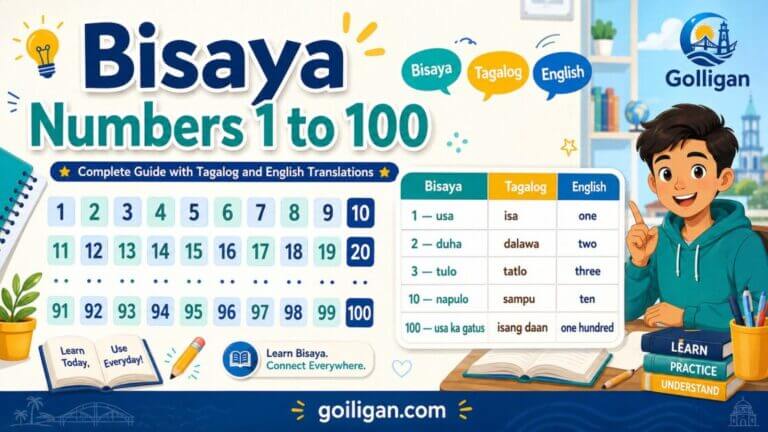

If you already speak Tagalog, learning Bisaya is easier than starting from zero. You already understand how Philippine languages feel: sentence flow, particles, respect markers, pronouns, repetition, context, and the way meaning often depends on tone.
Explore this topic: Iligan Travel & Logistics Hub
But here is the trap: Bisaya is not just “Tagalog with different words.” It has its own rhythm, grammar habits, sounds, expressions, humor, and regional variations. If you assume everything works the same, you will get confused fast.
The good news? Tagalog speakers have a big advantage. With the right method, you can build basic conversational Bisaya faster by using Tagalog as a bridge, not as a crutch.
This guide gives you a practical learning path, essential phrases, mistakes to avoid, and daily habits that help you understand and speak Bisaya with confidence in Iligan City.
Why Tagalog Speakers Can Learn Bisaya Faster Than You Think
Tagalog and Bisaya, especially Cebuano/Binisaya, both belong to the Philippine language family under the wider Austronesian language group. That means they share deep historical roots, some familiar word patterns, and certain sentence habits.
You will notice similarities in how people express respect, ask questions, repeat words, shorten everyday speech, and mix English into conversation. You may also recognize some words immediately.
But the big difference is meaning and usage. Some words sound familiar but mean something else. Some grammar patterns feel close but not identical. Some Bisaya phrases cannot be translated word-for-word into Tagalog without sounding stiff.
For a Tagalog speaker, realistic goals look like this:
- First 7 days: recognize greetings, polite phrases, and basic questions.
- First 30 days: handle simple daily conversation.
- First 60 to 90 days: understand common casual speech, especially if listening daily.
- 3 to 6 months: build conversational comfort with consistent practice.
You do not need perfect grammar at the start. You need useful phrases, listening exposure, and courage to speak.
Understanding the Key Differences Between Bisaya and Tagalog
1. Pronunciation and Sound
Bisaya pronunciation can sound sharper, quicker, and more clipped than Tagalog depending on the region. Cebuano/Bisaya speakers may stress words differently, and some vowels may sound shorter in everyday conversation.
For example:
| Tagalog | Bisaya | Meaning |
|---|---|---|
| Magandang umaga | Maayong buntag | Good morning |
| Salamat | Salamat | Thank you |
| Kumusta ka? | Kumusta ka? / Kumusta? | How are you? |
| Saan ka pupunta? | Asa ka padulong? | Where are you going? |
Some words are easy because they are identical or close. But do not get too comfortable. The language goblin waits in the false friends.
2. Sentence Flow
Tagalog speakers often try to translate directly. That can sound unnatural.
Tagalog: Saan ka pupunta?
Bisaya: Asa ka padulong? or Asa ka moadto?
Tagalog: Anong ginagawa mo?
Bisaya: Unsa imong gibuhat?
Tagalog: Kumain ka na ba?
Bisaya: Nikaon na ka?
You can see the structure is not impossible. It just needs new default patterns.
3. Common False Friends
Some Bisaya words sound like Tagalog words but mean something different.
| Word | Bisaya Meaning | Tagalog Meaning |
|---|---|---|
| libog | confused | sexual desire / libido |
| langgam | bird | ant |
| gamot | root | medicine |
| kamot | hand | scratch |
| palit | buy | replace |
| daan | old | road / way |
| gubat | war | forest |
This is why you should learn Bisaya words in sentences, not only as isolated vocabulary.
4. Bisaya Uses Many Short Everyday Particles
Bisaya has particles like ba, man, gyud/jud, ra, diay, lagi, bitaw, and unta. These carry tone and nuance.
Examples:
- Mao ba? = Is that so?
- Tinuod gyud. = Really true.
- Kani ra. = Just this.
- Diay? = Really? / So that’s the case?
- Unta. = Hopefully / I wish.
These small words are seasoning. Without them, your Bisaya may still be understandable, but less natural.
Essential Bisaya Phrases Every Tagalog Speaker Should Learn First
Start with phrases you will actually use. Do not memorize rare words first. Learn the “daily survival kit.”
Greetings and Basic Introductions
| English | Tagalog | Bisaya |
|---|---|---|
| Good morning | Magandang umaga | Maayong buntag |
| Good afternoon | Magandang hapon | Maayong hapon |
| Good evening | Magandang gabi | Maayong gabii |
| How are you? | Kumusta ka? | Kumusta ka? |
| I’m okay | Okay lang ako | Okay ra ko |
| What is your name? | Ano ang pangalan mo? | Unsa imong pangalan? |
| My name is… | Ang pangalan ko ay… | Ako si… / Ang akong pangalan kay… |
| Where are you from? | Taga-saan ka? | Taga-asa ka? |
| I am from Manila | Taga-Manila ako | Taga-Manila ko |
Courtesy Phrases
| English | Tagalog | Bisaya |
|---|---|---|
| Thank you | Salamat | Salamat |
| Thank you very much | Maraming salamat | Daghang salamat / Salamat kaayo |
| You’re welcome | Walang anuman | Walay sapayan |
| Excuse me | Excuse po / Paumanhin | Tabi / Excuse ko |
| Sorry | Pasensya na | Pasayloa ko / Sorry |
| Please | Pakiusap | Palihug |
| Yes | Oo | Oo |
| No | Hindi | Dili |
Daily Questions
| English | Tagalog | Bisaya |
|---|---|---|
| Where is this? | Nasaan ito? | Asa ni? |
| Where are you going? | Saan ka pupunta? | Asa ka padulong? |
| How much is this? | Magkano ito? | Tagpila ni? |
| What is this? | Ano ito? | Unsa ni? |
| Who is that? | Sino iyon? | Kinsa na? |
| Why? | Bakit? | Ngano? |
| When? | Kailan? | Kanus-a? |
| Can I ask? | Pwede magtanong? | Pwede mangutana? |
Food and Shopping Phrases
| English | Tagalog | Bisaya |
|---|---|---|
| I will buy food | Bibili ako ng pagkain | Mopalit ko og pagkaon |
| I am hungry | Gutom ako | Gigutom ko |
| I am thirsty | Nauuhaw ako | Giuhaw ko |
| This is delicious | Masarap ito | Lami ni |
| How much? | Magkano? | Tagpila? |
| Too expensive | Masyadong mahal | Mahal ra kaayo |
| Do you have water? | May tubig ba kayo? | Naa moy tubig? |
Emergency and Help Phrases
| English | Tagalog | Bisaya |
|---|---|---|
| Help! | Tulong! | Tabang! |
| I need help | Kailangan ko ng tulong | Nanginahanglan ko og tabang |
| I am lost | Naliligaw ako | Nawala ko |
| I don’t understand | Hindi ko maintindihan | Wala ko kasabot |
| Please repeat | Pakiulit | Usba palihug |
| Speak slowly | Dahan-dahan lang | Hinay-hinay lang |
Step-by-Step Learning Method for Tagalog Speakers
Week 1 to 2: Build Your Foundation
Your goal is not fluency yet. Your goal is recognition.
Focus on:
- Greetings
- Pronouns
- Question words
- Numbers
- Food words
- Direction words
- Polite expressions
Daily routine:
- 10 minutes phrase review
- 10 minutes listening to Bisaya clips
- 5 minutes speaking out loud
- 5 minutes writing sample sentences
Start with phrases like:
- Kumusta ka?
- Asa ka?
- Unsa ni?
- Tagpila ni?
- Wala ko kasabot.
- Palihug.
- Salamat kaayo.
Week 3 to 4: Learn Sentence Patterns
Once you have phrases, build patterns.
Pattern 1: Naa koy…
Meaning: I have…
Examples:
- Naa koy pangutana. = I have a question.
- Naa koy problema. = I have a problem.
- Naa koy kwarta. = I have money.
Pattern 2: Gusto ko…
Meaning: I want…
Examples:
- Gusto ko mokaon. = I want to eat.
- Gusto ko makat-on og Bisaya. = I want to learn Bisaya.
- Gusto ko moadto sa Iligan. = I want to go to Iligan.
Pattern 3: Wala ko…
Meaning: I do not have / I did not…
Examples:
- Wala ko kasabot. = I did not understand.
- Wala koy kwarta. = I have no money.
- Wala ko kahibalo. = I do not know.
Week 5 to 8: Speak in Mini-Conversations
Now start speaking even if your grammar has dents and scratches.
Practice this:
A: Kumusta ka?
B: Okay ra ko. Ikaw?
A: Okay ra pud. Asa ka padulong?
B: Moadto ko sa merkado.
A: Unsa imong paliton?
B: Mopalit ko og pagkaon.
Translation:
A: How are you?
B: I’m okay. You?
A: I’m okay too. Where are you going?
B: I’m going to the market.
A: What will you buy?
B: I will buy food.
Month 3: Increase Listening and Real Conversation
By month three, listening becomes the big unlock.
Do this:
- Watch Bisaya Facebook videos.
- Follow Cebuano/Bisaya creators.
- Listen to Bisaya radio clips or podcasts.
- Ask friends to speak Bisaya slowly.
- Repeat lines out loud.
- Record yourself speaking.
- Keep a small notebook of phrases you hear often.
Fluency does not arrive like a lightning bolt. It sneaks in through repetition.
Best Resources and Tools for Learning Bisaya as a Tagalog Speaker
1. YouTube Lessons
Search for:
- Cebuano for beginners
- Learn Bisaya phrases
- Bisaya grammar basics
- Cebuano conversation practice
- Tagalog to Bisaya lessons
Use YouTube for pronunciation, because text alone cannot teach rhythm.
2. Omniglot Cebuano Phrase List
Omniglot has a useful Cebuano phrase list with greetings, travel questions, and basic expressions like Maayong buntag, Salamat, Walay sapayan, and Tagpila kini?
3. TESDA-Style Learning Discipline
You do not need a formal class to build consistency. Treat Bisaya like a daily skill.
Use this 30-minute routine:
- 10 minutes vocabulary
- 10 minutes listening
- 5 minutes speaking
- 5 minutes review
Do it daily for 30 days. That small habit beats one giant weekend study session.
4. Language Exchange Partners
Find a Bisaya-speaking friend and ask for simple correction.
Say:
Pwede ko nimo tudluan og Bisaya?
Can you teach me Bisaya?
Ayaw lang ko kataw-i kaayo. Beginner pa ko.
Please don’t laugh too much. I’m still a beginner.
That line alone can turn people into patient teachers.
5. Flashcards
Make flashcards with three parts:
- Bisaya word
- Tagalog meaning
- Sample sentence
Example:
Bisaya: Palit
Tagalog: Bili
Sentence: Mopalit ko og tubig.
Avoid learning only word pairs. Always include a sentence.
Common Mistakes Tagalog Speakers Make When Learning Bisaya
Mistake 1: Directly Translating Tagalog
Tagalog: Gusto kong kumain.
Wrong direct style: Gusto nako kaon
More natural: Gusto ko mokaon.
Direct translation can help at first, but you must eventually learn Bisaya patterns.
Mistake 2: Trusting Similar Words Too Much
False friends are sneaky.
Libog in Bisaya means confused. In Tagalog, it can mean sexual desire.
Langgam in Bisaya means bird. In Tagalog, it means ant.
Kamot in Bisaya means hand. In Tagalog, it means scratch.
Do not assume. Ask for context.
Mistake 3: Ignoring Listening Practice
Many learners memorize words but freeze when real Bisaya speakers talk fast. Listening is not optional. It is the bridge from textbook Bisaya to street Bisaya.
Mistake 4: Using Formal Phrases Only
Some phrase lists are correct but too formal for everyday use.
For example, Ikasubo ko can mean sorry, but in casual situations people may simply say sorry, pasensya, or pasayloa ko, depending on context.
Mistake 5: Being Afraid to Sound Funny
You will sound funny. That is not failure. That is the entrance fee.
Most locals appreciate the effort, especially if you are respectful and willing to be corrected.
Immersion Strategies Without Moving to the Visayas or Mindanao
You do not need to move to Cebu, Davao, Cagayan de Oro, or Iligan to learn Bisaya. You can create a tiny language island around you.
1. Change Your Content Diet
Follow Bisaya creators on Facebook, TikTok, YouTube, and Instagram. Even 10 minutes a day helps.
Search for:
- Bisaya vlog
- Cebuano comedy
- Bisaya news
- Bisaya podcast
- Bisaya cooking
- Bisaya travel
2. Label Things Around Your House
Put small labels:
- door = pultahan
- water = tubig
- food = pagkaon
- hand = kamot
- house = balay
- money = kwarta
- chair = lingkuranan
3. Speak One Sentence Daily
Use one Bisaya sentence every day.
Examples:
- Gigutom ko.
- Kapoy ko.
- Mopalit ko og kape.
- Naa koy trabaho.
- Wala ko kasabot.
4. Use Bisaya in Real Tasks
When buying food, asking prices, messaging a friend, or commenting online, try one simple Bisaya phrase.
Small public practice builds courage.
5. Keep a “Confusing Words” List
Write down words that trick you. Example:
- libog = confused
- langgam = bird
- gamot = root
- kamot = hand
- palit = buy
- daan = old
Review them weekly.
Mini Bisaya Practice Plan for Tagalog Speakers
15-Minute Daily Plan
If you are busy, do this:
- 5 minutes: review 10 words
- 5 minutes: listen to short Bisaya audio/video
- 5 minutes: speak 3 sentences out loud
30-Minute Daily Plan
Better for steady progress:
- 10 minutes: phrases
- 10 minutes: listening
- 5 minutes: writing sentences
- 5 minutes: speaking practice
60-Minute Weekly Deep Practice
Once a week:
- Watch one Bisaya video.
- Write 10 new words.
- Create 5 sentences.
- Speak with a Bisaya friend or record yourself.
- Review mistakes.
First 100 Words to Learn
Start with useful words:
| Bisaya | Tagalog | English |
|---|---|---|
| ako | ako | I / me |
| ikaw | ikaw | you |
| siya | siya | he / she |
| kita | tayo | we / us |
| sila | sila | they |
| unsa | ano | what |
| kinsa | sino | who |
| asa | saan | where |
| ngano | bakit | why |
| kanus-a | kailan | when |
| tubig | tubig | water |
| pagkaon | pagkain | food |
| balay | bahay | house |
| kwarta | pera | money |
| trabaho | trabaho | work |
| dalan | daan/kalsada | road |
| daan | luma | old |
| bag-o | bago | new |
| lami | masarap | delicious |
| kapoy | pagod | tired |
| sakit | masakit | painful |
| maayo | mabuti | good |
| bati | pangit / hindi maganda | bad / ugly |
| dako | malaki | big |
| gamay | maliit | small |
| duol | malapit | near |
| layo | malayo | far |
| karon | ngayon | now |
| ugma | bukas | tomorrow |
| gahapon | kahapon | yesterday |
| palit | bili | buy |
| kaon | kain | eat |
| inom | inom | drink |
| lakaw | lakad/alis | walk/go |
| adto | punta doon | go there |
| ari | punta dito | come here |
| tabang | tulong | help |
| sabot | intindi | understand |
| kahibalo | alam | know |
| pangutana | tanong | question |
FAQs About Learning Bisaya as a Tagalog Speaker
How do beginners learn Bisaya?
Start with greetings, question words, daily phrases, and listening practice. Learn words in sentences, not isolated vocabulary. Practice speaking one or two lines every day.
Is Bisaya easy to learn?
For Tagalog speakers, Bisaya is easier than many foreign languages because it shares Philippine language roots and familiar cultural context. But it still requires practice because vocabulary, sentence patterns, and pronunciation differ.
What is “I love you” in Visayas?
In Cebuano/Bisaya, “I love you” is commonly Gihigugma tika or Nahigugma ko nimo. In casual modern speech, many people also say I love you or mix English and Bisaya.
Can Tagalog people understand Bisaya?
Not automatically. Some words may sound familiar, but Bisaya and Tagalog are separate languages. A Tagalog speaker may understand bits and pieces, especially with exposure, but not full conversations without learning.
How long does it take to learn Bisaya if you speak Tagalog?
You can learn basic survival phrases in one to two weeks. Simple conversations may be possible in one to three months with daily practice. Comfortable conversational ability may take several months, depending on exposure and speaking practice.
What is the difference between Bisaya and Cebuano?
Cebuano is a specific language. Bisaya is often used broadly for Visayan languages or casually to refer to Cebuano/Binisaya, especially in Cebu and many parts of Mindanao.
Is Bisaya harder than Tagalog?
It depends on your background. For Tagalog speakers, the hardest parts are false friends, listening speed, sentence patterns, and regional variations. But it is very learnable with consistent exposure.
What are the most common Bisaya words?
Common words include unsa, kinsa, asa, ngano, kaon, inom, tubig, balay, kwarta, lami, kapoy, tabang, salamat, and palihug.
Conclusion: Your Action Plan to Start Learning Bisaya Today
Learning Bisaya as a Tagalog speaker is not starting from zero. You already have a useful language foundation. What you need now is a bridge: phrases first, listening daily, sentence patterns, false-friend awareness, and real conversation.
Start with three actions today.
First, memorize 20 survival phrases. Second, follow three Bisaya content creators. Third, practice one sentence out loud every day for the next 30 days.
Do not wait until you feel ready. Language grows when you use it. Your first sentences may wobble, but that is part of the climb.
For Tagalog speakers, learning Bisaya is a sulit skill because it opens warmer conversations, smoother travel, better local connection, and a deeper appreciation of how rich Philippine languages really are.